
Elevator modernization is no longer just about smoother rides, cleaner fixtures, and updated controls. Building owners now expect connected systems that can support real-time monitoring, security cameras, touchscreen panels, destination controls, access systems, and future smart building integrations.
That shift changes the role of elevator traveling cable. The traveling cable is no longer just a bundle of power and control conductors. It has become the data backbone between the elevator car and the controller.
At CED Elevator & Electrical, we help contractors source elevator parts that match the needs of modern projects, from traveling cable and modernization products to service and repair parts for active field work.
For contractors searching elevator traveling cable, CAT6 ethernet cable for elevators, smart elevator systems, or elevator shaft wiring, this guide explains why high-performance data cable belongs in more modernization quotes.
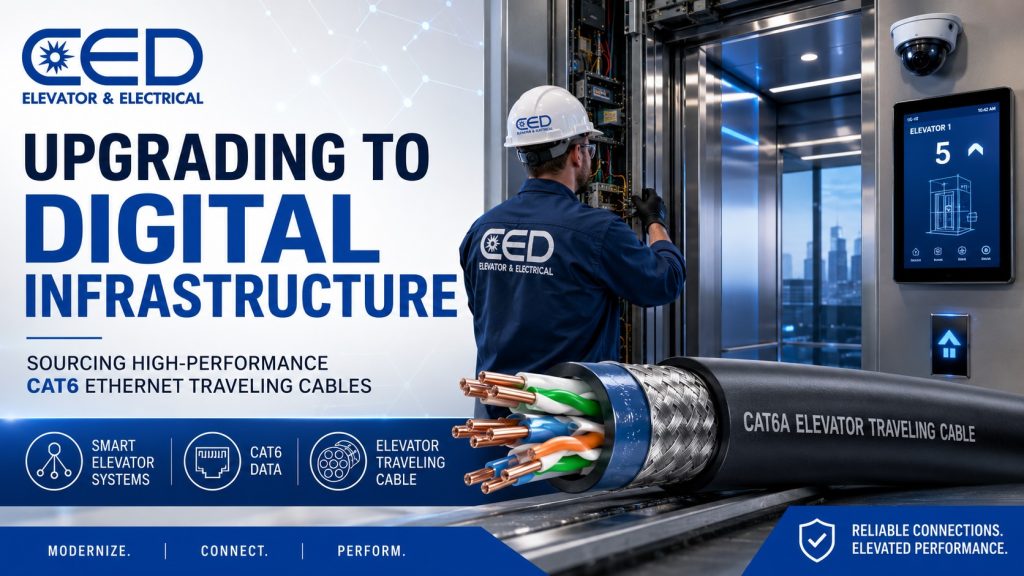
Why Elevator Modernization Now Needs Data Infrastructure
Older elevator systems were built around buttons, relays, basic control circuits, door operators, lighting, alarms, and phone lines. Modern elevators are different. Today’s building owners want connected elevator technology that supports safety, convenience, diagnostics, and tenant experience.
Common upgrades now include:
- IP security cameras
- Touchless call systems
- Touchscreen car operating panels
- Digital displays
- Access control
- Remote monitoring
- Smart diagnostics
- Emergency communication upgrades
- Destination dispatch systems
- Building management system connections
Each upgrade depends on stable data transfer. A smart panel or camera cannot perform well when the hoistway wiring was never designed for modern network traffic.
That is where CAT6 ethernet cable for elevators becomes a high-value specification.
What Makes Elevator Traveling Cable Different?
Standard building wire is not designed to move with an elevator car. A traveling cable must flex every time the car moves, carry power and data safely, and survive daily motion inside the hoistway.
CED’s traveling cable guide explains that elevator traveling cable connects the elevator cab to fixed controls and carries power, control signals, and communication data between the car and controller. The guide also notes that data, video, and voice systems often require shielded twisted pairs, coaxial, CAT5, or CAT6 lines to reduce signal problems.
For contractors, this means elevator shaft wiring must be selected for:
- Flex life
- Signal shielding
- Travel height
- Load support
- Voltage requirements
- Conductor count
- Data performance
- Code compliance
- Installation environment
- Future system expansion
A standard ethernet cable does not belong in a moving elevator application. A purpose-built ethernet traveling cable does.
Featured Product: TCSCME14 CAT6A Ethernet Traveling Cable
CED’s TCSCME14 CAT6A Ethernet Traveling Cable is built for modern connected elevator systems that need dependable data communication between the car and controller.
According to CED’s product listing, the TCSCME14 integrates:
- Two CAT6A 4-pair data cables
- Six shielded 20 AWG control pairs
- One 5/32 inch galvanized steel strength member
- Cotton-braid-reinforced black PVC jacket
- Sequential footage marking every 24 inches
- CAT6 performance up to 295 ft
- 300 V and 60°C rating
- UL ETT and cUL ETT FT1 approvals
- RoHS 3 compliance
CED lists applications that include elevator car ethernet and IP systems, security and CCTV camera connections, touchscreen control panels, multimedia displays, smart building integrations, diagnostics, and modernization projects requiring combined data, control, and strength in one cable.
That makes this cable a practical upsell for modernization contractors who want to prepare buildings for the next generation of elevator technology.
Why CAT6 Matters for Smart Elevator Systems
A basic control circuit can operate with traditional conductors. A smart elevator system needs more.
CAT6 ethernet traveling cable helps support higher-speed digital communication for devices that rely on network connectivity. That matters when a cab includes cameras, displays, smart panels, or monitoring equipment.
For contractors, CAT6 capability can support:
- Cleaner IP camera performance
- Better data transmission between car and controller
- More reliable display communication
- Future smart device integration
- Stronger modernization proposals
- Fewer limitations after the cab upgrade
- Reduced need for future rewiring
A building owner may not ask for every smart feature on day one. But once the hoistway is open and the modernization project is active, it is often the right time to install a cable that can support the next phase.
The High-Margin Upsell Contractors Should Not Miss
Modernization work creates a rare window of opportunity. The elevator is already being evaluated. The owner is already budgeting. The contractor is already discussing controls, fixtures, doors, safety upgrades, and cab improvements.
That is the right time to ask:
Will this elevator need cameras, access control, smart displays, monitoring, or future digital upgrades?
When the answer is yes, a higher-performance traveling cable can become a smart add-on instead of a future change order.
CAT6 ethernet traveling cable can help contractors position modernization around:
- Better long-term value
- Future-ready infrastructure
- Reduced repeat labor
- Stronger owner confidence
- Better compatibility with connected systems
- Cleaner upgrade planning
- More complete modernization packages
A low-cost cable choice may satisfy today’s minimum requirement, but it can restrict tomorrow’s technology.
Elevator Shaft Wiring and Signal Protection
Hoistways can be tough electrical environments. Elevator motors, controllers, lighting, moving cables, and surrounding building systems can create noise that affects sensitive data lines.
CED’s traveling cable guide notes that shielding is important when elevators include data, video, or voice systems because shielded twisted pairs reduce electromagnetic interference.
That is why contractors should consider signal protection early. A camera feed, touchscreen interface, or monitoring system may fail to perform properly when the cable path does not support clean communication.
The right cable helps protect:
- Video quality
- Data consistency
- Controller communication
- Smart panel performance
- Access control reliability
- Diagnostic accuracy
- Building integration signals
When to Specify CAT6 Ethernet Traveling Cable
CAT6 ethernet traveling cable should be considered when the elevator project includes or may later include:
- IP cameras inside the cab
- Digital media displays
- Touchscreen controls
- Tenant communication screens
- Access control readers
- Smart monitoring hardware
- Remote diagnostic systems
- Security system connections
- IoT building integrations
- High-end modernization scopes
Even when those devices are not part of the first phase, owners often appreciate future-ready planning. A contractor who brings up digital infrastructure early can stand out as a modernization advisor, not just an installer.
Why Steel Core Support Matters
Traveling cable must handle movement, weight, and mechanical stress. For taller travel distances or demanding use, support strength becomes a critical part of cable selection.
CED identifies the TCSCME14 under its steel core traveling cable category, and the product includes a galvanized steel strength member for mechanical support.
That matters because data performance alone is not enough. Elevator cable must match both communication needs and physical hoistway conditions.
Sourcing Matters as Much as Specification
Contractors need more than a product name. They need reliable sourcing, clear part support, product documentation, and quick access when schedules are tight.
CED Elevator & Electrical positions itself as a one-stop source for elevator parts and value-added services, stocking elevator products for more than 25 years and supporting parts for major elevator manufacturers and systems. The company lists regional locations serving the Western US, Mid-Atlantic, Eastern US, Southern US, and Mid-Western US.
Contractors can source through CED locations, including:
For elevator contractors managing modernization work across multiple regions, that footprint can help simplify procurement.
How to Build the Upgrade Into the Sales Conversation
A stronger modernization proposal should explain why data-ready cable matters. Contractors can frame the conversation around risk, flexibility, and owner value.
Suggested talking points:
- “This modernization is the best time to prepare for future IP systems.”
- “Smart displays, cameras, and monitoring need reliable data pathways.”
- “A CAT6 ethernet traveling cable can reduce future rewiring.”
- “This helps the elevator support modern building technology.”
- “The cable selection should match both current controls and future upgrades.”
That kind of conversation helps owners understand why the cable choice affects more than the initial installation.
Contractor Checklist Before Ordering
Before sourcing an elevator traveling cable, review:
- Elevator travel height
- Cable support requirements
- Controller requirements
- Voltage rating
- Number of control pairs
- Data requirements
- Camera or display plans
- Access control needs
- Monitoring system requirements
- Hoistway conditions
- Required approvals
- Existing cable configuration
- Future modernization phases
For help choosing the right cable, review CED’s Elevator Traveling Cable Guide or browse James Monroe Traveling Cable options.
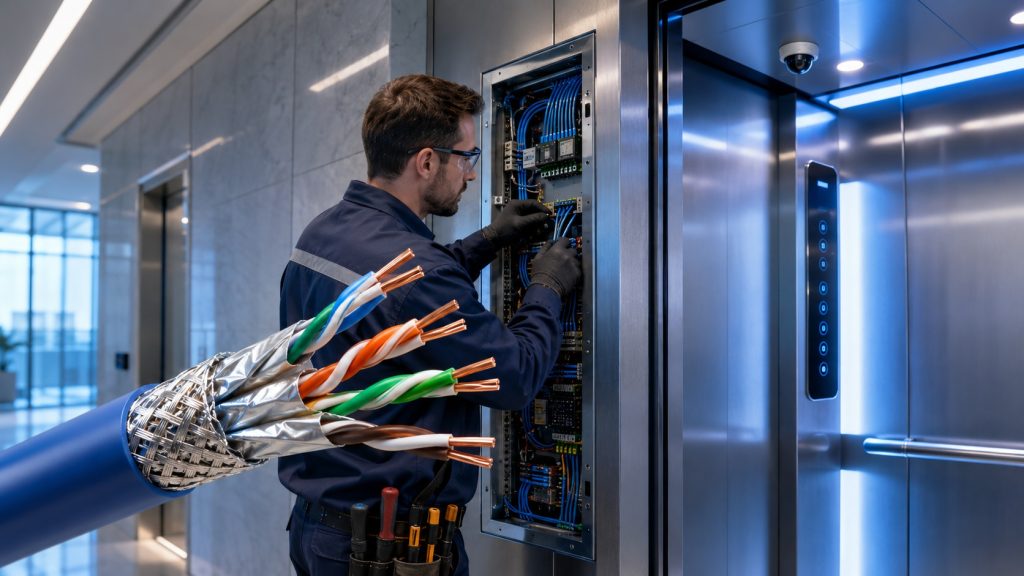
Building Smarter Modernization Packages
Smart elevator systems are becoming a normal part of commercial building expectations. Owners want better visibility, easier monitoring, improved security, upgraded user interfaces, and equipment that can support future tenant demands.
That puts elevator contractors in a strong position. By specifying CAT6 ethernet traveling cable during modernization, contractors can offer a more complete solution and create a higher-value scope.
At CED Elevator & Electrical, our team helps source the parts contractors need for modernization, service, repair, new construction, and connected elevator upgrades. For projects that require high-performance data, control, and mechanical support in one cable, the TCSCME14 CAT6A Ethernet Traveling Cable is a smart place to start.
FAQs
What is an elevator traveling cable?
An elevator traveling cable is a flexible cable that moves with the elevator car and carries power, control signals, and communication data between the car and controller.
Can CAT6 ethernet cable be used in elevators?
CAT6 ethernet can be used in elevator systems when it is part of a purpose-built elevator traveling cable designed for motion, flexing, shielding, and hoistway conditions.
Why do smart elevator systems need CAT6 data cable?
Smart elevator systems may use IP cameras, touchscreens, displays, access control, monitoring, and diagnostics. These features need reliable data communication between the car and controller.
What is TCSCME14 used for?
TCSCME14 is used for elevator car ethernet and IP systems, CCTV cameras, touchscreen panels, multimedia displays, smart building integrations, diagnostics, and modernization projects.
Where can contractors source CAT6 elevator traveling cable?
Contractors can source CAT6 elevator traveling cable through CED Elevator & Electrical, including the TCSCME14 CAT6A Ethernet Traveling Cable.