
Elevator door operator troubleshooting should begin by separating the fault into three areas: door protection and reopening signals, mechanical door and clutch alignment, and the operator control itself. A reversal edge that detects an obstruction but does not reopen the doors may point to an interface or controller problem rather than the detector alone. Repeated interlock failures can come from clutch geometry, worn pickup components, sill resistance, or door alignment. When legacy equipment creates recurring callbacks, a GAL replacement operator, MAC closed-loop upgrade, or ECI-compatible component retrofit may offer a better long-term solution than repeated isolated repairs. GAL’s MOVFR documentation confirms that reopening, clutch operation, motor current, door speed, and obstruction detection interact as one coordinated system.
At CED Elevator & Electrical, we approach door problems from the complete system rather than assuming every failure comes from the operator board. Doors, tracks, hangers, clutches, interlocks, detectors, motors, and controller signals all have to work together. CED currently supplies complete operators, headers, tracks, clutches, interlocks, sensors, bearings, belts, and other door-system components for repair and modernization work.
Safety Note: Elevator door locks, interlocks, car-top equipment, and operator circuits are safety-critical components. Diagnosis, adjustment, and testing should be completed by qualified elevator personnel using the manufacturer procedure and applicable code requirements.
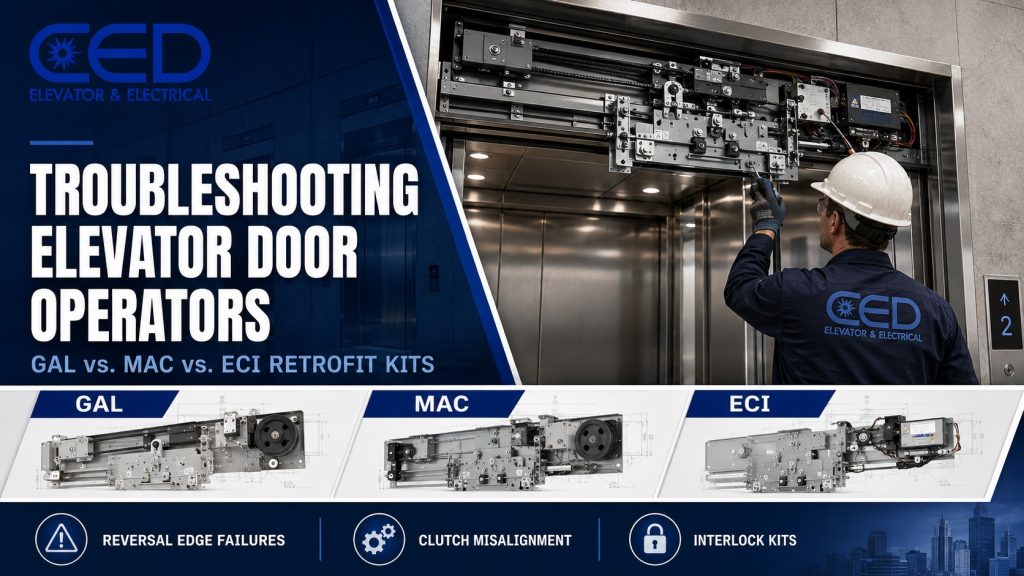
1. Start With the Door Reversal Edge
When doors begin closing and immediately reverse, the detector often gets blamed first.
Start by checking for obvious physical causes:
- Debris inside the sill
- Misaligned door panels
- Binding rollers or hangers
- Damaged detector cables
- Loose edge connections
- Intermittent reopening inputs
- Excessive closing resistance
GAL’s MOVFR system provides a useful troubleshooting example. When its compatible infrared detector senses an obstruction, the operator activates its REOPEN relay. That relay sends the reopening request to the elevator controller, but the MOVFR then waits for a Door Open command from the main controller before actually reopening.
That distinction matters.
If the detector reacts and the REOPEN indication appears but the doors stay closed, we would verify the controller interface and Door Open command before replacing the edge.
For detailed GAL-specific settings, technicians can reference the official GAL MOVFR Installation and Adjusting Manual.
2. Check Mechanical Resistance Before Changing Parameters
An operator cannot electronically compensate for every mechanical problem.
Before increasing torque or modifying speed settings, check the door manually under the approved service procedure. Look for binding, hanger resistance, worn rollers, tight tracks, improper door overlap, loose linkage, or a dragging sill condition.
GAL specifically instructs technicians to move the doors manually during setup and check for binding to protect bearing life and establish proper operation.
Repeated stall-reverse events can also signal excessive resistance. On MOVFR equipment, motor current above the configured stall-reverse threshold activates the reopen function, making a mechanical problem appear electrical if the door movement is not checked first.
3. Diagnose Clutch Misalignment and Interlock Problems
Elevator door interlock adjustment should never begin by randomly moving the lock contacts.
First determine whether the clutch is correctly picking up the hoistway equipment.
Watch for:
- Clutch contacting rollers too early or too late
- Pickup rollers outside proper alignment
- Door hanger sag changing clutch height
- Bent clutch links
- Worn keeper or contact assemblies
- Excessive play in linkage
- Doors that close but fail to establish the safety circuit
GAL’s MOVFR procedure shows how closely clutch geometry affects operation. For that specific system, GAL calls for defined crank-arm and clutch-link positions in both the closed and open positions and recommends finishing adjustment by rechecking the fully closed position.
CED stocks GAL interlock assemblies and replacement contact components, including complete MOH interlock products within our Elevator Door Operators & Parts inventory.
4. GAL Door Operator Replacement
GAL’s MOVFR uses a closed-loop VVVF system with a three-phase AC motor, drive, PC board, optical door-position sensing, programmable parameters, and obstruction detection.
For buildings experiencing obsolete controls, noisy mechanical operation, repeated callbacks, inconsistent reopening, or worn linkage, replacing the legacy operator can make more sense than continuing individual repairs.
Our related guide on GAL Linear Door Operators for Elevator Modernization covers when a complete upgrade becomes the stronger option.
5. MAC Door Operator Upgrades
A GAL door operator replacement is not the only elevator modernization path.
Legacy MAC Type M, PMSSC, and HPMSSC operators can be upgraded using an OEM closed-loop conversion package available through KONE Spares. KONE states that the upgrade can help where heavy doors move slowly, sill debris causes stalls before interlocks make, shaft pressure affects closing, or more repeatable operation is needed.
The closed-loop conversion continuously controls door direction, velocity, acceleration, and motor torque rather than relying exclusively on older control methods.
That can make a retrofit attractive when the mechanical door equipment remains serviceable but the operator controls have become the weak point.
6. What About ECI Door Equipment?
ECI systems require careful component identification before ordering.
Current parts catalogs still identify ECI-specific items including headers, interlock contacts, limit switches, pickup rollers, chain rollers, sprocket assemblies, and other door hardware.
For an ECI retrofit, we recommend documenting the existing opening, handing, header dimensions, operator configuration, clutch, interlock arrangement, supply voltage, and door type before selecting replacement hardware.
That survey helps determine whether the best repair is an ECI-compatible component replacement, updated interlock package, or complete operator modernization.
Repair the Fault or Modernize the Operator?
Repair makes sense when the failure is isolated and the remaining door equipment is mechanically sound.
Modernization becomes more attractive when we see recurring board faults, obsolete components, repeated interlock callbacks, inconsistent reversal, excessive noise, worn linkage, or difficult parts availability.
The goal is not simply getting the doors through one more cycle. We want predictable operation that technicians can maintain and support for years.
Browse CED’s inventory of universal door operators and replacement interlock kits for elevator repair and modernization projects.