
Preventive elevator maintenance focuses on finding wear, adjustment needs, and deteriorating components before they cause a shutdown. Reactive maintenance begins after a fault or failure occurs. Reactive service may appear less expensive when equipment is operating normally, but recurring callbacks, emergency labor, expedited parts, downtime, and secondary component damage can increase long-term costs. The better strategy depends on equipment condition, usage, age, and the Maintenance Control Program.
Elevator maintenance costs are not limited to the technician’s invoice.
When equipment fails unexpectedly, building owners and contractors may also face tenant disruption, emergency callbacks, expedited freight, unavailable parts, and extended downtime.
At CED Elevator & Electrical, we support elevator contractors with parts for planned maintenance and urgent repair work. From a parts-sourcing perspective, one difference is clear: identifying wear before failure creates more options than waiting until an elevator is already out of service.
What Is Preventive Elevator Maintenance?
Preventive elevator maintenance is scheduled work intended to identify wear, deterioration, adjustment needs, and developing faults before they become equipment failures.
Depending on the elevator and its maintenance program, attention may include:
- Door rollers and operators
- Interlocks
- Relays and contactors
- Batteries
- Brakes
- Hydraulic seals and packing
- Pumps and valves
- Traveling cable
- Wire rope or suspension components
- Controllers and electrical connections
CED’s preventive maintenance guidance emphasizes that routine attention can identify worn components before they cause shutdowns and emergency repair costs.
For a deeper component-focused overview, see our guide to preventive elevator maintenance.
What Is Reactive Elevator Maintenance?
Reactive maintenance begins after a problem has already affected operation.
Examples include:
- Elevator doors will not close
- Unit stops responding
- Hydraulic leak causes performance problems
- Relay or contactor fails
- Battery failure creates a communication issue
- Leveling problem becomes severe
- Controller fault creates a shutdown
- Worn component breaks during service
Reactive work is unavoidable in some situations. Even well-maintained equipment can fail unexpectedly.
The concern is relying on breakdowns as the primary maintenance strategy.
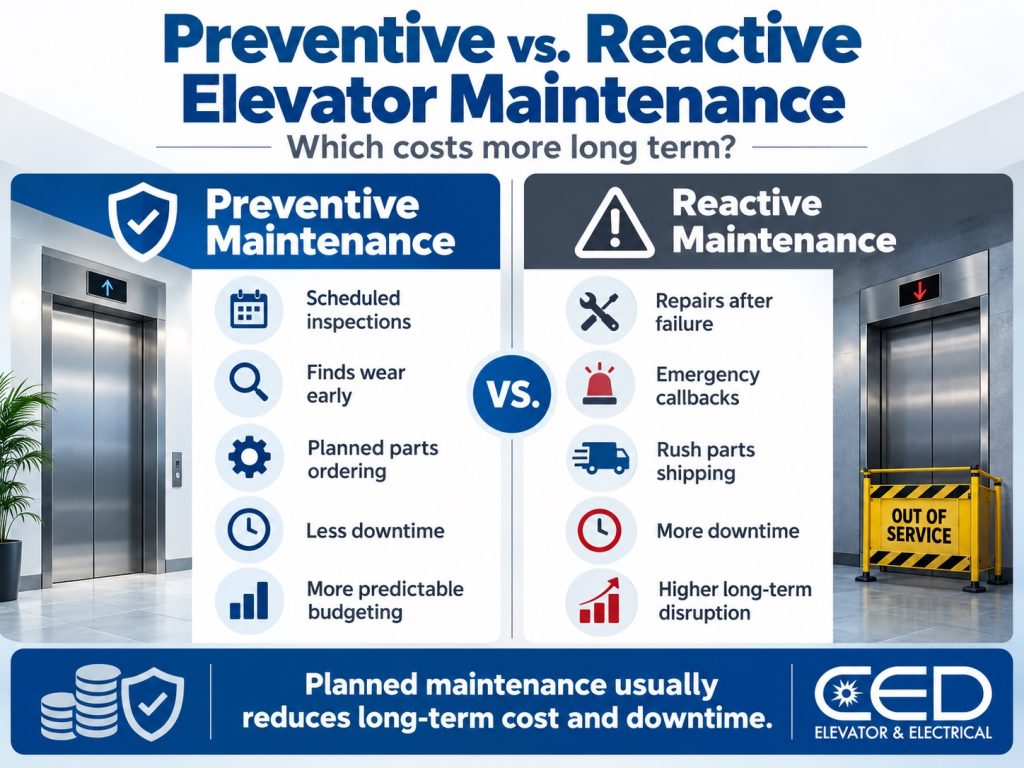
Preventive vs. Reactive Elevator Maintenance
| Factor | Preventive Maintenance | Reactive Maintenance |
|---|---|---|
| Timing | Before failure | After failure |
| Parts sourcing | Can be planned | Often urgent |
| Labor scheduling | More predictable | May require emergency response |
| Downtime | Often reduced | Can be extended |
| Freight | Normal ordering may be possible | Expedited shipping may be needed |
| Component damage | Wear addressed earlier | Failure may affect related components |
| Budgeting | More predictable | Costs can fluctuate |
| Lifecycle planning | Easier | Often delayed until failure |
Preventive maintenance does not eliminate every breakdown. It reduces the need to discover every worn component through failure.
Why Reactive Elevator Maintenance Can Cost More
Emergency Labor
A scheduled maintenance visit and an unexpected shutdown at night, on a weekend, or during a busy building period can have very different labor implications.
CED’s analysis of low-bid maintenance agreements notes that overtime labor, emergency callbacks, excluded repairs, and unclear response terms can turn an inexpensive contract into a more costly arrangement over time.
Rush Parts Shipping
A worn component found during planned maintenance may be ordered before failure.
When the elevator is already down, that same component may become an urgent shipment.
The difference matters even more when the required part is uncommon, obsolete, or located at another distribution point.
Longer Downtime
If a technician arrives without the required replacement part, the elevator may remain unavailable while the component is identified, sourced, shipped, and installed.
For multifamily buildings, hospitals, offices, hotels, and other high-traffic properties, downtime can have operational consequences beyond repair cost.
Secondary Damage
A component that remains in service after significant deterioration may place additional stress on related equipment.
That does not mean every worn part creates a chain reaction, but early identification gives the maintenance provider an opportunity to address deterioration before a more complicated failure develops.
Does Preventive Maintenance Always Cost Less?
Not on every individual service visit.
Preventive maintenance requires scheduled technician time and sometimes replacement of components that have not completely failed.
The financial benefit becomes clearer when evaluating the elevator over a longer period.
A building should compare:
scheduled maintenance + planned parts replacement
against:
emergency calls + unexpected parts + premium labor + expedited freight + downtime + repeat failures
The lowest monthly maintenance bill is not automatically the lowest lifecycle cost.
How Maintenance Control Programs Fit In
Preventive maintenance should not simply mean replacing parts on an arbitrary calendar.
ASME A17.1 addresses elevator maintenance, testing, inspection, alteration, and repair, while the Maintenance Control Program framework establishes equipment-specific maintenance requirements and records. ASME currently lists A17.1-2025 as the latest edition, although the enforceable edition depends on what the local Authority Having Jurisdiction has adopted.
Building owners and contractors should therefore base maintenance on the equipment, applicable code, manufacturer information, operating conditions, and documented maintenance program rather than assuming every elevator needs exactly the same schedule.
Review ASME A17.1 elevator safety standards
Which Elevator Parts Benefit Most From Early Attention?
Door Components
Doors cycle far more frequently than many other elevator components.
Wear involving rollers, operators, tracks, and interlocks can eventually lead to nuisance callbacks or shutdowns.
Relays, Contactors and Fuses
Small electrical components can stop an entire elevator when they fail.
Planned inventory of common electrical parts can make repairs faster.
Hydraulic Components
Leaks, deteriorating packing, valve problems, and abnormal hydraulic performance can provide warning signs before complete failure.
Batteries and Emergency Equipment
Battery-powered communication and backup systems should not wait for a failure during an actual emergency to reveal that replacement was needed.
Obsolete Components
Older equipment creates another problem: a part may still function today but become increasingly difficult to source.
Preventive maintenance provides time to identify alternatives before the elevator is down.
Parts Planning Is Part of Preventive Maintenance
Preventive elevator maintenance works best when maintenance findings lead to parts planning.
CED stocks service and repair products from more than 100 manufacturers, including GAL replacement parts, Texacone packing, electrical components, batteries, starters, contactors, fuses, ventilation equipment, and related service products.
Contractors can browse our elevator service and repair parts to prepare for planned maintenance and shorten sourcing time when replacement components are identified.
Warning Signs a Reactive Strategy Is Becoming Expensive
Look for patterns such as:
- Increasing callbacks
- Repeated door failures
- Recurring leveling problems
- Repeated relay or contactor replacement
- Hydraulic leaks returning
- Frequent shutdowns
- Growing rush-order frequency
- Long waits for obsolete components
- Multiple repairs to the same system
- Increasing downtime
One failure does not prove that maintenance is inadequate.
Repeated failures are the stronger signal.
Prevent Failure When Possible, Prepare for It When Not
The long-term maintenance question should not be framed as preventive or reactive service.
Every elevator will eventually need repairs.
The stronger strategy is to use preventive maintenance to identify predictable wear early, plan replacement parts, track recurring problems, and reduce the number of failures that become emergencies.
At CED Elevator & Electrical, we help contractors support that approach with service and repair parts, alternate sourcing, inventory assistance, Just-In-Time delivery, and regional distribution across the United States.
Planned maintenance creates time to source the right component. Reactive failure takes that time away.
Frequently Asked Questions
What is preventive elevator maintenance?
Preventive maintenance is scheduled work used to inspect, adjust, clean, lubricate, test, and replace deteriorating components before they create equipment failures.
Is preventive elevator maintenance cheaper than reactive maintenance?
It can reduce long-term costs by limiting emergency callbacks, expedited parts orders, downtime, and recurring failures. Actual cost depends on equipment age, condition, usage, and maintenance requirements.
Can preventive maintenance stop every elevator breakdown?
No. Unexpected failures can still happen. Preventive maintenance is intended to reduce avoidable failures and identify predictable wear earlier.
Why is reactive elevator repair expensive?
Reactive work may involve emergency labor, rush shipping, extended downtime, difficult parts sourcing, and repairs performed after equipment has already failed.
What parts should elevator contractors keep available?
The answer depends on the installed equipment, but commonly planned items can include door components, relays, contactors, fuses, batteries, hydraulic seals, packing, and other known wear parts.