
For hydraulic elevator modernization and repair, Maxton and EECO are established control-valve options, while Texacone serves a different but closely related role. Texacone specializes primarily in hydraulic cylinder packing, seals, alignment products, and repair components rather than complete elevator control valves. For smooth leveling, we match the valve to flow rate, operating pressure, car speed, oil temperature, controller sequence, and existing power-unit configuration. Maxton provides multiple mechanical and electronic control-valve families, while EECO offers valves for applications ranging from residential and LULA systems through larger commercial hydraulic elevators.
At CED Elevator & Electrical, we also look beyond the valve itself. The pump, motor, reservoir, oil condition, temperature control, cylinder packing, and electrical controls all influence how smoothly a hydraulic elevator starts, levels, and stops.
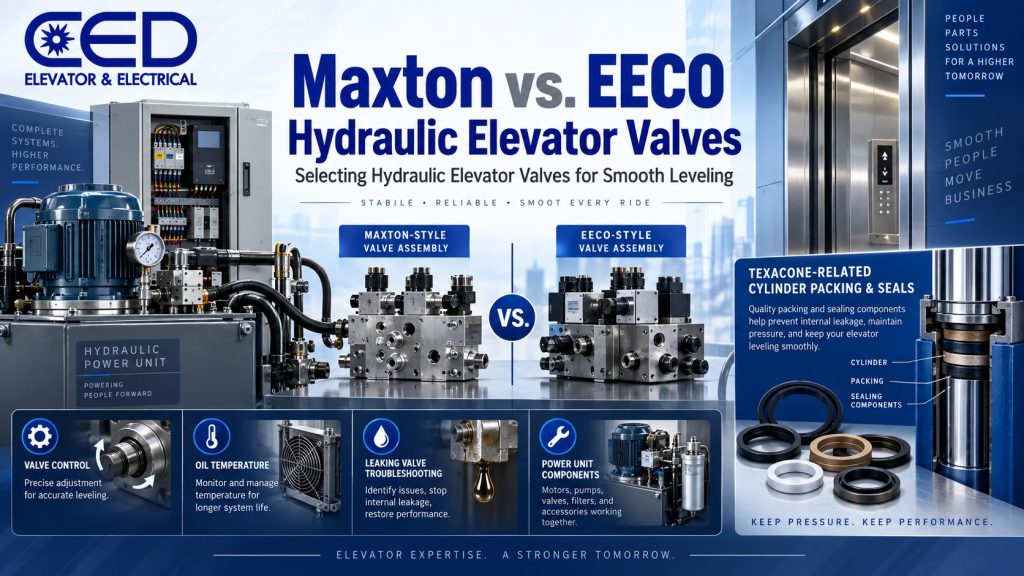
Maxton vs. EECO vs. Texacone: What Is the Difference?
| Manufacturer | Primary Role | Best Fit |
|---|---|---|
| Maxton | Hydraulic elevator control valves | Modernization, replacement, leveling control |
| EECO | Hydraulic elevator control valves | Replacement, modernization, multiple flow applications |
| Texacone | Cylinder packing, seals, repair products | Leakage, friction, cylinder-head service |
This distinction matters when troubleshooting a rough ride.
A technician may initially suspect the valve when the actual problem is cylinder friction, worn packing, contaminated oil, incorrect temperature, or a control-sequence issue.
Maxton Hydraulic Valves: Strong Adjustment and Support Options
Maxton manufactures hydraulic elevator control valves including UC-series mechanical valves and electronic options. Its published procedures cover bypass, acceleration, transition, leveling speed, stopping, relief settings, and troubleshooting.
Maxton also emphasizes that valve procedures are intended for skilled hydraulic elevator professionals. Its documentation notes that proper valve adjustment affects ride quality, pump performance, motor performance, and overall system efficiency.
Technicians searching for a Maxton valve adjustment guide should always identify the exact valve model before making changes. UC1, UC2, UC4, UC4M, UC4MR, and electronic valve procedures are not interchangeable.
The official Maxton valve adjustment procedures provide model-specific technical references.
When We Consider Maxton
Maxton can be a strong choice when a project requires:
- Predictable leveling control
- Replacement of an aging hydraulic valve
- Readily available service information
- Rebuild and maintenance components
- Compatibility with common hydraulic power-unit configurations
EECO Hydraulic Valves: Broad Application Range
EECO also produces dedicated hydraulic elevator control valves.
Its current catalog includes valve families for residential, LULA, and commercial applications. EECO states that valve adjustment should be performed by qualified hydraulic elevator professionals and recommends clean hydraulic oil with proper filtration.
Some EECO designs incorporate temperature compensation to help maintain more consistent operation as hydraulic oil viscosity changes.
That can be important because hydraulic elevator behavior can change as the machine room and oil move from a cold morning startup to sustained operation later in the day.
When EECO Makes Sense
We may evaluate EECO when:
- Replacing an existing EECO valve
- Matching a particular flow requirement
- Retaining familiar field-service components
- Modernizing an older hydraulic installation
- Temperature consistency is a major concern
The correct selection should always be based on actual job data rather than choosing a manufacturer by brand name alone.
Where Texacone Fits
Texacone should not be treated as a direct Maxton or EECO valve competitor.
Its products focus heavily on hydraulic elevator cylinder heads, packing sets, seals, alignment, sanding, and repair solutions. CED carries Texacone products such as Sure-Fit repair components, alignment systems, sanding sleeves, O-ring splicing products, and cylinder-head identification resources.
That becomes important when poor leveling is actually caused by friction at the cylinder.
Texacone notes that cylinder misalignment, damaged plungers, temperature extremes, and packing conditions can contribute to leakage or excessive friction.
A perfectly adjusted control valve cannot fully compensate for a mechanical cylinder problem.
What Causes a Hydraulic Elevator Valve to Leak?
A hydraulic elevator valve leaking internally or externally may involve several different conditions.
Common troubleshooting areas include:
- Contamination around valve seats
- Worn seals or O-rings
- Damaged solenoid components
- Worn pistons or guides
- Incorrect relief settings
- Contaminated hydraulic oil
- Cylinder packing leakage
- Improper valve sizing
- Excessive operating temperature
Maxton’s troubleshooting documentation specifically identifies debris, damaged valve components, worn seals, and contaminated strainers as possible causes of poor operation and drift.
Rather than repeatedly adjusting a valve to compensate for another fault, we prefer diagnosing the complete hydraulic system.
Hydraulic Oil Temperature Can Change Leveling
Oil viscosity changes with temperature.
When a hydraulic elevator runs too hot or too cold, technicians may see changes in acceleration, leveling, stopping, noise, or ride consistency.
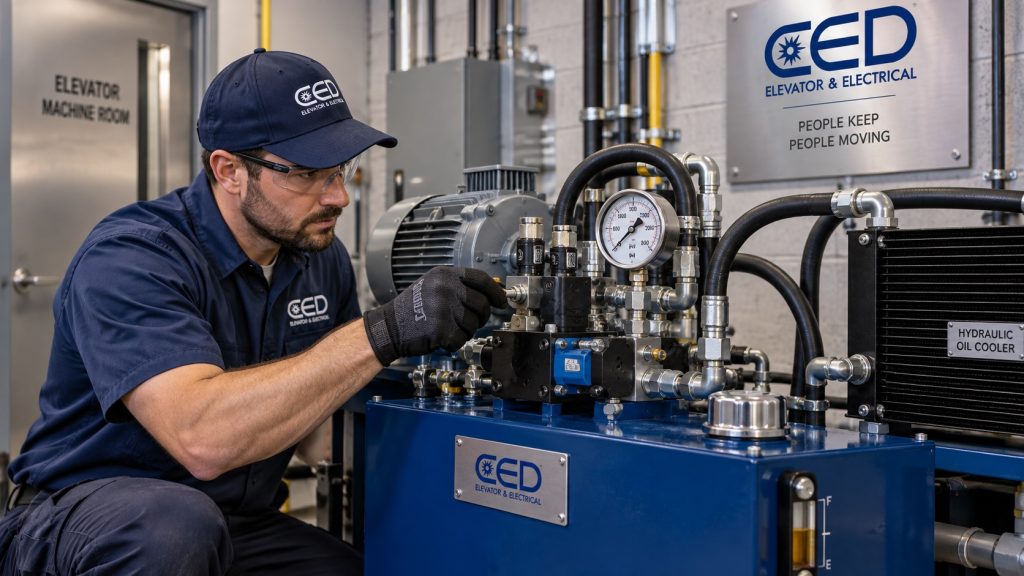
That is where an elevator hydraulic oil cooler or tank heater may become part of the solution.
CED hydraulic power units can be configured with optional oil coolers, tank heaters, pressure gauges, low-oil switches, low-pressure switches, scavenger pumps, and other accessories.
For buildings with high elevator usage or machine-room temperature swings, stabilizing oil temperature can help maintain more predictable hydraulic performance.
Know the Hydraulic Elevator Power Unit Components
The valve does not work alone.
The four primary hydraulic elevator power unit components are:
- Reservoir to hold hydraulic oil
- Pump to move oil into the cylinder
- Motor to drive the pump
- Control valve to regulate flow, acceleration, leveling, and stopping
CED explains these components in our hydraulic elevator power unit guide.
A leveling complaint can originate from any part of that system.
Rebuild the Valve or Replace It?
A rebuild may make sense when the valve body remains serviceable and the problem is isolated to replaceable seats, seals, coils, solenoids, or internal components.
Replacement deserves consideration when:
- Valve wear is extensive
- Adjustment no longer produces stable operation
- Parts availability is becoming difficult
- The power unit is undergoing modernization
- Flow requirements have changed
- Repeated callbacks outweigh repair cost
Maxton documentation even recommends considering valve overhaul or replacement on a periodic basis when adverse operating conditions are present.
Selecting the Right Hydraulic Elevator Components
At CED Elevator & Electrical, we supply hydraulic elevator components for contractors working on repairs, modernization, and complete power-unit projects.
Rather than treating Maxton, EECO, and Texacone as interchangeable products, we match the actual problem to the right component. That may mean a control valve, rebuild kit, cylinder packing, oil cooler, heater, pump, motor, or complete hydraulic elevator power unit.
For technicians sourcing direct replacement parts, having the valve model, serial number, flow requirement, pressure, oil type, motor data, and existing power-unit information available can make component selection much faster.