
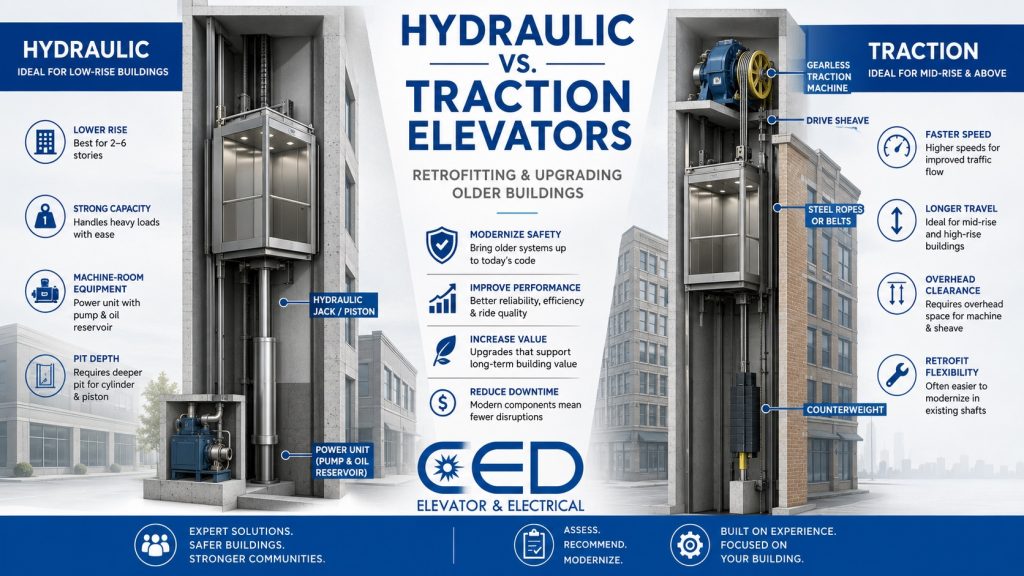
When comparing hydraulic vs. traction elevators, the best modernization path depends on building height, travel distance, rated capacity, traffic demand, existing hoistway dimensions, pit depth, overhead clearance, machine-space configuration, and the condition of reusable equipment. Hydraulic systems remain practical for many low-rise buildings because they use a pump, valve, oil reservoir, and cylinder to move the car. Gearless traction systems use a motor, drive sheave, suspension ropes or belts, and counterweight, making them better suited to faster speeds and greater travel. Modern machine-room-less traction equipment can even fit some existing hydraulic hoistways, but a traction elevator conversion requires detailed layout and structural review rather than a simple equipment swap.
How Hydraulic Elevators Work
A hydraulic elevator raises the car by pumping hydraulic oil from a reservoir into a cylinder. Pressure moves the piston, which lifts the elevator. During descent, a control valve releases oil back into the tank.
A typical hydraulic power unit contains:
- Hydraulic oil reservoir
- Electric motor
- Pump
- Control valve
- Shutoff and safety components
- Optional cooler, heater, gauges, or scavenger equipment
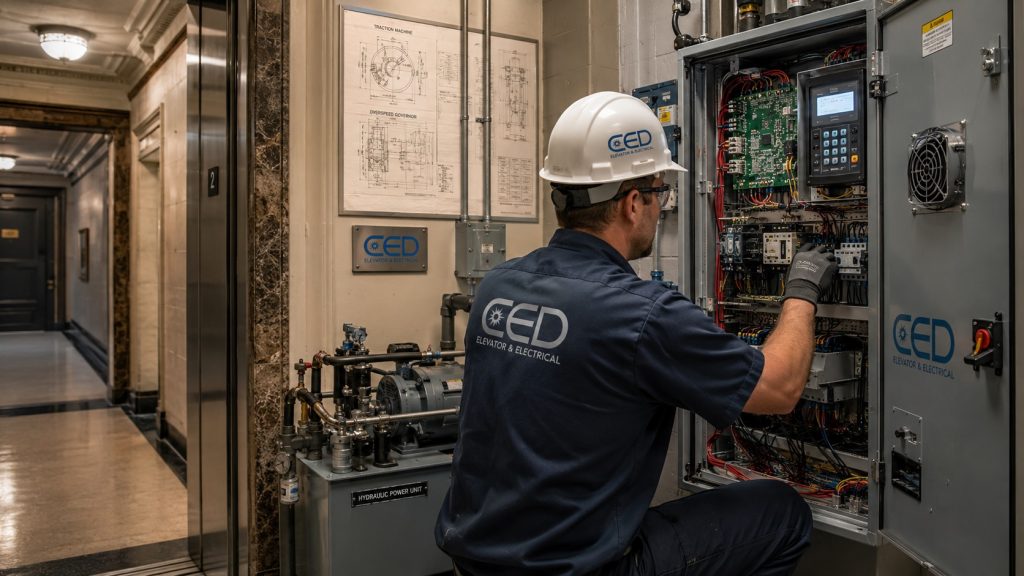
CED’s hydraulic power units use this same fundamental arrangement, with the pump providing pressure and the valve controlling acceleration, leveling, and descent.
Hydraulic equipment remains attractive for many low-rise commercial properties because of its straightforward mechanical arrangement and ability to handle substantial loads.
As one current example, the Otis HydroFit hydraulic elevator supports rated loads from 2,100 to 5,000 pounds, speeds of 100 to 125 feet per minute, up to four stops, and maximum travel of 26 feet 6 inches. Those figures are product-specific, but they illustrate where modern hydraulic systems commonly compete.
How Gearless Traction Elevators Differ
Traction elevators suspend the car and counterweight using ropes or belts that pass over a drive sheave.
Instead of lifting the entire car through hydraulic pressure, the motor moves a balanced car-counterweight system.
Modern gearless traction equipment can provide:
- Higher travel speeds
- Greater vertical travel
- More stops
- Strong performance under heavier traffic
- Reduced dependence on hydraulic oil
- Machine-room-less configurations
- Regenerative-drive options on certain systems
For comparison, one current KONE machine-room-less traction replacement system supports speeds from 150 to 350 feet per minute, 2,000 to 5,000-pound capacities, up to 15 landings, and as much as 150 feet of travel.
This helps explain why traction becomes increasingly attractive as building height and traffic increase.
Hydraulic vs. Traction Elevator Comparison
| Factor | Hydraulic | Gearless Traction |
|---|---|---|
| Typical application | Low-rise | Low to mid-rise and higher |
| Drive system | Oil pump and cylinder | Motor, sheave and counterweight |
| Speed | Generally lower | Generally higher |
| Heavy loads | Strong low-rise option | Strong with correct configuration |
| Oil system | Required | Not required for drive motion |
| Machine room | Traditional systems may require one | Modern MRL systems may eliminate it |
| Energy profile | Motor works heavily during ascent | Counterweight reduces lifting imbalance |
| Retrofit complexity | Existing hydraulic equipment may be reusable | Hydraulic-to-traction conversion can be extensive |
The right answer still depends on the actual elevator rather than building height alone.
When Hydraulic Elevator Replacement Makes Sense
A hydraulic elevator replacement does not always mean removing the entire elevator.
If the cylinder, rails, entrances, cab structure, and other major components remain serviceable, modernization may focus on replacing aging equipment such as:
- Power unit
- Controller
- Valve
- Pump and motor
- Door operator
- Traveling cable
- Fixtures
- Electrical components
At CED Elevator & Electrical, we supply coordinated elevator modernization materials including hydraulic fittings, controllers, wire rope, traveling cable, door operators, fixtures, and related equipment for modernization contractors. CED notes that modernization scope should reflect the condition of the machine, hydraulic equipment, controller, wiring, doors, rails, and safety systems.
Keeping a hydraulic configuration can make sense when the building remains low-rise and the existing hoistway already works well for that system.
When Traction Elevator Conversion Becomes Attractive
A traction elevator conversion may make sense when an owner wants higher speed, greater traffic capability, reduced hydraulic equipment, or a longer-term modernization strategy.
Modern traction replacements can sometimes reuse portions of an existing elevator footprint. KONE, for example, markets a machine-room-less traction replacement system designed to fit existing hydraulic and traction shafts.
That does not mean every hydraulic shaft can accept traction equipment without changes.
Contractors may need to evaluate:
- Hoistway width and depth
- Counterweight location
- Rail loading
- Machine support requirements
- Electrical service
- Controller location
- Pit configuration
- Buffers
- Top-of-car clearance
- Door and entrance compatibility
A conversion therefore often approaches a complete modernization or replacement rather than a component-level upgrade.
Pit Depth and Overhead Clearance Can Decide the Project
Older buildings frequently have one major constraint: space.
Pit and overhead dimensions must accommodate the selected equipment plus required safety clearances.
Traction systems may require room for the car, counterweight, buffers, suspension equipment, machine components, and top-of-hoistway clearances. Hydraulic layouts must accommodate jack or cylinder arrangements, pit equipment, piping, and applicable safety requirements.
Exact requirements vary by elevator model, configuration, jurisdiction, and adopted code. This is why contractors should never assume that a modern traction package will fit because the existing hydraulic cab dimensions look adequate.
Modern MRL technology has expanded retrofit possibilities considerably. Schindler, for example, offers low-rise MRL traction equipment specifically positioned as an alternative to hydraulic systems and designed around space-saving installation.
For technical planning, contractors can also review the manufacturer’s layout drawings and the applicable ASME A17.1/CSA B44 requirements for the jurisdiction.
Modernize the System, Not Just One Component
An older elevator may have a new controller but still suffer from worn door equipment, obsolete wiring, an aging hydraulic power unit, or outdated fixtures.
That is why we recommend planning modernization as a system.
A coordinated package can include the controller, drive, power unit or machine, door operator, traveling cable, hoistway wiring, fixtures, and safety-related components.
Our related elevator modernization upgrade vs. replacement guide explains how contractors can determine which components remain worth retaining and which should be replaced.
Choosing the Right Upgrade for an Older Building
For a three-story building with moderate traffic and a serviceable hydraulic layout, upgrading the hydraulic system may offer the most practical value.
For a larger building requiring faster travel, more stops, stronger traffic handling, or elimination of aging hydraulic equipment, modern gearless traction may provide a better long-term platform.
At CED Elevator & Electrical, we help elevator contractors source modernization components for both hydraulic and traction projects. The strongest retrofit begins with accurate field dimensions, equipment condition data, rated load, travel, speed requirements, pit depth, overhead clearance, and the building’s long-term operating goals.