
A hydraulic elevator power unit works hard every day. When it runs smoothly, most building owners never think about it. When heat, vibration, pump noise, leveling problems, or slow travel starts showing up, the entire elevator system can become a service headache.
At CED Elevator & Electrical, we support elevator contractors, service mechanics, modernization teams, OEMs, and building professionals with quality elevator parts, replacement hydraulic power units, modernization materials, and field-ready components. CED Elevator & Electrical has stocked elevator products and parts for more than 25 years and supports service, repair, modernization, new construction, and OEM elevator work nationwide.
This guide covers hydraulic power unit troubleshooting, why hydraulic power unit oil temperature matters, how vibration points to deeper system problems, and when replacement or modernization may be the better long-term solution.
What an Elevator Hydraulic Power Unit Does
A hydraulic power unit is the heart of a hydraulic elevator system. It provides the force needed to move the elevator car by pushing hydraulic oil into the cylinder. A typical unit includes the tank, pump, motor, valve, oil, piping connections, and controls that work together to raise, lower, stop, and level the car.
CED Elevator & Electrical’s hydraulic elevator power units use trusted components such as Seim pumps, Imperial motors, and Maxton valves, with standard features that include a tank with hinged lid, oil level and temperature gauge, and seismic anchoring brackets.
When heat or vibration develops, the issue may come from one component, but the cause often involves the full system.
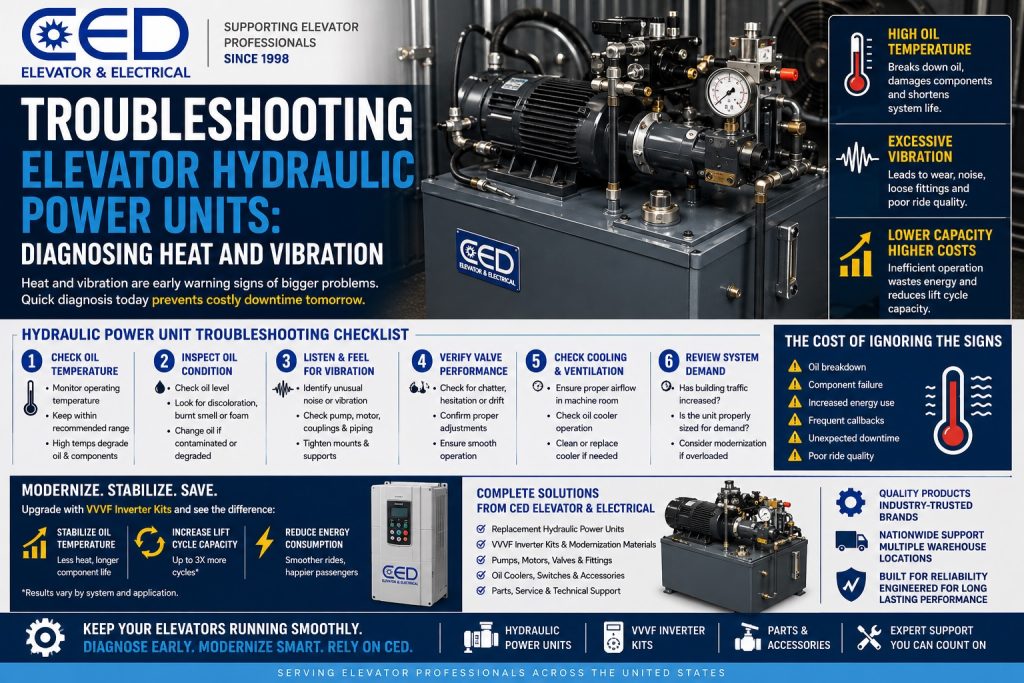
Common Signs of Hydraulic Power Unit Trouble
Hydraulic elevator problems rarely start as complete failure. Most units give warning signs before a major shutdown.
Common symptoms include:
- High oil temperature
- Burning oil smell
- Elevator machine room heat buildup
- Excessive pump noise
- Motor humming
- Vibration through the tank or piping
- Rough starts or stops
- Slow up travel
- Inconsistent leveling
- Valve chatter
- Oil foaming
- Frequent callbacks
- Breaker trips or starter issues
- Longer run times during peak usage
- Reduced ride quality
When these symptoms appear together, the power unit should be evaluated before heat damages the oil, seals, pump, motor, valve, or related components.
Why Hydraulic Power Unit Oil Temperature Matters
Heat is one of the biggest enemies of a hydraulic elevator system. Hydraulic oil does more than move the elevator. It lubricates parts, transfers energy, supports valve performance, protects seals, and helps keep the system stable.
When oil temperature climbs too high, performance can change quickly. Hot oil becomes thinner, which can affect valve control, leveling accuracy, pump efficiency, and ride quality. Over time, excessive heat can accelerate oxidation, create varnish, damage seals, increase leakage, and shorten component life.
For elevator teams searching hydraulic power unit oil temperature, the key question is not just “How hot is the oil?” The better question is “Why is the unit creating or holding excess heat?”
What Causes High Oil Temperature?
High operating temperature can come from several system conditions.
1. Excessive Lift Cycles
A hydraulic elevator serving a busy commercial property, medical building, school, retail location, or multifamily building may run more cycles than the original system was designed to handle. Frequent up trips create heat because the motor and pump work hard to move oil under pressure.
2. Undersized or Aging Power Unit
Older units may struggle with current traffic demands. A power unit that was acceptable years ago may now be overloaded due to higher building occupancy, tenant changes, heavier use, or aging components.
3. Poor Machine Room Ventilation
Heat trapped in the machine room can increase oil temperature and reduce cooling between cycles. If the room is hot, the oil tank cannot shed heat effectively.
4. Valve Adjustment Problems
Improper valve settings can create inefficiency, poor leveling, longer run time, and extra heat. A valve that is not controlling flow properly may force the unit to work harder than necessary.
5. Worn Pump or Motor
A worn pump may become noisy, inefficient, or unable to maintain expected flow. A motor under electrical or mechanical stress can also increase heat and vibration.
6. Contaminated or Degraded Oil
Old or contaminated hydraulic oil can reduce system performance. Dirt, water, oxidation, or wrong oil viscosity can contribute to overheating, valve issues, and component wear.
7. Missing or Failed Oil Cooler
Some applications need additional cooling. CED Elevator offers optional oil coolers on hydraulic power unit configurations, along with other options such as pressure gauges, low oil switches, low pressure switches, scavenger pumps, shut off valves, pipe rupture valves, isolation couplings, motor starters, and fittings.
Why Vibration Should Never Be Ignored
Vibration in a hydraulic power unit can travel through the tank, piping, building structure, and elevator system. It may sound like buzzing, rattling, pulsing, humming, or shaking during operation.
Common causes of vibration include:
- Pump wear
- Motor imbalance
- Coupling issues
- Cavitation
- Air in the hydraulic oil
- Loose mounting points
- Pipe movement
- Valve chatter
- Incorrect fittings
- Tank resonance
- Poor isolation
- Pressure fluctuation
- Flow restriction
Vibration can create more than noise. It can loosen fittings, stress piping, affect ride quality, increase wear, and lead to repeated service calls.
For teams searching elevator hydraulic pump repair, vibration is one of the signs that the pump, motor, valve, oil, piping, or full power unit may need deeper evaluation.
Step-by-Step Hydraulic Power Unit Troubleshooting
Step 1: Document the Symptoms
Before changing parts, document what is happening.
Track:
- When the heat or vibration occurs
- Whether it happens on up travel, down travel, or both
- Oil temperature readings
- Machine room temperature
- Number of cycles before symptoms appear
- Noise location
- Motor amperage, where applicable
- Ride quality complaints
- Leveling issues
- Valve performance
- Recent repairs or adjustments
- Oil condition
- Building traffic patterns
This helps determine whether the issue is thermal, mechanical, electrical, hydraulic, or a combination.
Step 2: Check Oil Level and Oil Condition
Low oil can cause pump noise, cavitation, heat, poor performance, and unsafe operation. Contaminated oil can also affect valve response and component life.
Look for:
- Low oil level
- Foaming
- Darkened oil
- Burnt smell
- Water contamination
- Sludge or varnish
- Excess debris
- Incorrect oil type
CED hydraulic power units include oil level and temperature gauges as standard features, which makes routine inspection easier for service teams.
Step 3: Read the Oil Temperature
A single temperature reading may not tell the whole story. Record temperature at startup, during normal operation, after peak traffic, and after repeated cycles.
Important questions include:
- How quickly does the oil heat up?
- Does the oil cool down between cycles?
- Does the temperature rise only during heavy use?
- Is the machine room also hot?
- Has the usage pattern changed?
- Is an oil cooler installed?
- Is the cooler working properly?
If heat builds faster than the system can release it, the building may need a cooling upgrade, power unit modernization, or a VVVF inverter solution.
Step 4: Inspect Pump and Motor Behavior
Pump and motor issues often show up as noise, vibration, slow travel, heat, or inconsistent performance.
Check for:
- Motor humming
- Pump growling
- Unusual startup noise
- Excess vibration during up travel
- Longer run times
- Higher electrical load
- Leaks around fittings
- Worn or aging components
- Evidence of cavitation
CED’s hydraulic power units are built with Seim pumps and Imperial motors, giving contractors a reliable replacement option when repair is no longer the best choice.
Step 5: Review Valve Operation
The valve controls oil flow and affects starts, stops, leveling, and ride quality. A valve issue can look like a pump issue if the full system is not tested.
Watch for:
- Rough starts
- Rough stops
- Leveling problems
- Valve chatter
- Heat generation
- Slow operation
- Pressure inconsistencies
CED hydraulic power units feature Maxton valves, which are known in elevator applications for control and reliability.
Step 6: Inspect Piping, Fittings, and Isolation
Vibration can be amplified by rigid piping, loose supports, incorrect fittings, or poor isolation. A small vibration at the power unit can become a larger building noise issue when transmitted through piping.
Check:
- Pipe supports
- Couplings
- Victaulic fittings
- Isolation couplings
- Elbows and reducers
- Loose brackets
- Contact points against walls or framing
- Movement during operation
CED lists Victaulic fittings, elbows, reducers, and isolation couplings among optional hydraulic power unit related features and components.
How Heat Breaks Down Hydraulic Oil
High temperature accelerates oil breakdown. As hydraulic oil degrades, it can become less effective at lubrication, heat transfer, and stable flow control.
Heat-related oil problems may include:
- Lower viscosity
- Oxidation
- Varnish formation
- Seal damage
- Valve sticking
- Increased leakage
- Reduced pump efficiency
- More noise
- Shorter equipment life
- Ride quality complaints
This creates a feedback loop. Hot oil causes component wear. Worn components create more heat. More heat causes faster oil breakdown. Eventually, the system may need more than a minor adjustment.
When Elevator Hydraulic Pump Repair Makes Sense
Repair may be practical when the pump issue is isolated, the unit is not severely aged, the motor and valve remain reliable, and the tank, controls, piping, and oil condition are still acceptable.
Repair may make sense when:
- The pump has a clear, isolated fault
- Vibration started recently
- Oil condition is acceptable
- Temperature remains controlled
- The motor tests within expected range
- The valve is functioning properly
- Parts are available quickly
- Building traffic demand has not outgrown the unit
CED supports service and repair teams with elevator parts, power products, hydraulic pipe and fittings, starters and contactors, lubricants and functional fluids, ventilation fans and coolers, test and measuring equipment, and other field supplies.
When Full Power Unit Replacement Is the Better Move
Sometimes replacing individual parts creates a cycle of repeated callbacks. A full replacement power unit may be the smarter long-term option when the system has several aging components or the building needs better reliability.
Replacement may be the better choice when:
- Heat problems keep returning
- Oil breaks down quickly
- Vibration remains after repair
- Pump, motor, and valve are all aging
- Parts are hard to source
- The unit is undersized for building demand
- Ride quality complaints continue
- The system needs modernization
- Downtime risk is too high
- The owner wants cleaner, quieter operation
CED Elevator & Electrical offers hydraulic elevator power units for new installations and modernization projects, with all components in the tank, quick installation, cost-effective configuration, and replacement parts stocked at local CED warehouses.
How VVVF Inverter Kits Improve Hydraulic Elevator Performance
Modern VVVF inverter kits can help stabilize hydraulic elevator operation by controlling motor speed and reducing harsh starts. Instead of starting the motor across the line at full demand, a variable-voltage, variable-frequency inverter allows smoother acceleration and more efficient operation.
For hydraulic elevators dealing with heat and heavy usage, a VVVF inverter modernization can help:
- Reduce starting current
- Smooth motor operation
- Lower heat generation
- Stabilize oil temperature
- Improve ride quality
- Reduce vibration
- Lower energy consumption
- Extend component life
- Support higher traffic demand
- Reduce mechanical stress
In many elevator modernization scenarios, VVVF technology can help increase lift cycle capacity, sometimes up to triple the previous practical operating capacity depending on the equipment, duty cycle, site conditions, and selected kit. It can also reduce energy consumption by improving how the motor starts and runs during elevator operation.
For contractors and building teams, this connects directly to the real field problem: fewer heat callbacks, fewer vibration complaints, and better performance from an existing hydraulic elevator system.
Heat, Vibration, and Energy Use Are Connected
Heat and vibration are not isolated problems. They often point to wasted energy. When a pump, motor, valve, or control system works harder than necessary, that extra stress becomes heat, noise, and wear.
A modernized power unit package or VVVF inverter kit can help the system operate more efficiently by reducing unnecessary electrical and mechanical stress.
The result may include:
- Lower operating temperatures
- More consistent oil performance
- Reduced motor stress
- Quieter operation
- Better ride comfort
- Improved leveling consistency
- Less service downtime
- Better energy performance
Why Modernization Is Often More Cost-Effective Than Repeated Repairs
A repair-first approach can work for minor issues. However, when callbacks repeat, modernization becomes easier to justify.
Modernization may help avoid:
- Multiple service visits
- Repeated oil changes
- Unplanned downtime
- Tenant complaints
- Heat-related shutdowns
- Continued vibration issues
- Premature pump or motor failure
- Ongoing energy waste
CED Elevator & Electrical provides modernization materials for the elevator industry, including hoistway and traveling cable, wire rope, duct, hydraulic fittings, SmartRise controllers, GAL Canada linear door operators, and ECC hall and cab fixtures.
Choosing the Right Replacement Hydraulic Power Unit
When selecting a replacement power unit, the goal is not just to match the old unit. The goal is to support the building’s current usage, ride quality expectations, installation conditions, and maintenance needs.
Important selection factors include:
- Elevator capacity
- Travel distance
- Motor requirements
- Pump sizing
- Valve selection
- Oil capacity
- Machine room conditions
- Cooling needs
- Seismic requirements
- Low oil switch requirements
- Low pressure switch needs
- Pressure gauge needs
- Pipe rupture valve requirements
- Installation access
- Local parts availability
CED’s power unit options include standard and optional features that allow contractors to configure the unit for the job, including oil coolers, tank heaters, pressure gauges, low oil switches, low pressure switches, scavenger pumps, shut off valves, pipe rupture valves, motor starters, fittings, elbows, and reducers.
Elevator Parts Support Across the United States
CED Elevator & Electrical supports elevator professionals across multiple regions, including Western US, Mid-Atlantic, Eastern US, Southern US, and Mid-Western US branch locations. The Eastern US location is in South Windsor, Connecticut, making CED a strong source for elevator contractors and service teams throughout New England and the Northeast.
For contractors working in Connecticut, Massachusetts, Rhode Island, New York, New Jersey, Pennsylvania, Maryland, Virginia, Texas, California, Illinois, and surrounding regions, local branch support helps reduce downtime and improve jobsite readiness.
Heat, vibration, pump noise, and oil temperature problems should not be treated as normal elevator behavior. These symptoms often point to inefficient operation, worn components, or a system that is ready for modernization.
For replacement hydraulic power units, elevator hydraulic pump repair parts, VVVF inverter modernization kits, hydraulic fittings, valves, motors, pumps, and field-ready elevator supplies, contact CED Elevator & Electrical.
Our team helps elevator professionals keep mechanics working, customers happy, and hydraulic elevator systems performing with confidence.
FAQs About Hydraulic Power Unit Troubleshooting
What causes high hydraulic power unit oil temperature?
High oil temperature can be caused by excessive lift cycles, poor machine room ventilation, worn pumps, motor stress, valve problems, degraded oil, undersized equipment, or missing cooling support.
Why is a hot hydraulic elevator power unit a problem?
Heat can break down hydraulic oil, reduce viscosity, damage seals, increase valve issues, create varnish, reduce pump efficiency, and shorten the life of elevator components.
What causes vibration in a hydraulic elevator power unit?
Vibration may come from pump wear, motor imbalance, cavitation, air in the oil, loose piping, valve chatter, poor isolation, or pressure fluctuation.
When should an elevator hydraulic pump be repaired?
Elevator hydraulic pump repair may make sense when the fault is isolated, the motor and valve are still reliable, oil condition is acceptable, and the power unit is not outdated or undersized.
When should a hydraulic power unit be replaced?
Replacement is often the better option when heat, vibration, pump noise, oil breakdown, leveling issues, and repeated callbacks continue despite repairs.
How can a VVVF inverter kit help a hydraulic elevator?
A VVVF inverter kit can smooth motor starts, reduce starting current, lower heat generation, stabilize oil temperature, reduce vibration, improve ride quality, and cut energy consumption.
Does CED Elevator & Electrical provide hydraulic power units?
Yes. CED Elevator & Electrical provides hydraulic elevator power units with trusted components, stocked replacement parts, standard oil level and temperature gauges, and optional features such as oil coolers, pressure gauges, switches, pipe rupture valves, motor starters, fittings, and more.