
Selecting the correct elevator wire rope requires more than matching diameter. At CED Elevator & Electrical, we look at rope function, construction, nominal diameter, strength grade, core type, lay, car speed, traction sheave design, groove profile, breaking strength, and OEM requirements before supplying a replacement set. An 8×19 Seale fiber-core rope is common for traction applications because its larger outer wires provide strong wear resistance, while Warrington constructions use alternating large and small outer wires for greater flexibility. Governor rope must match the governor manufacturer’s specified size, material, construction, and traction requirements. ASME A17.1/CSA B44 governs elevator suspension systems, while ASME A17.6 contains detailed material, inspection, and replacement requirements for steel wire ropes and other suspension means.
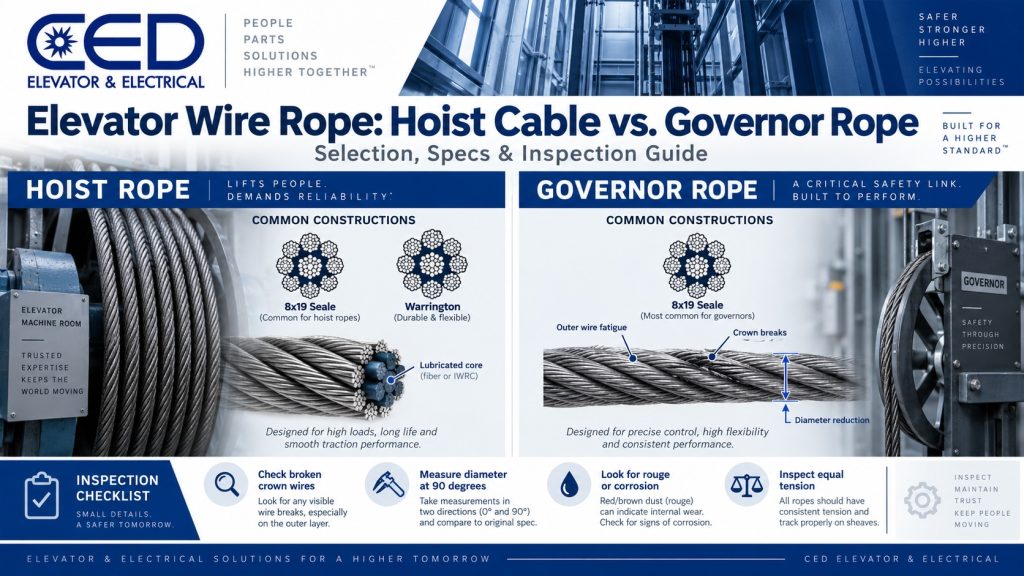
Hoist Rope vs. Governor Rope: They Are Not Interchangeable
Both may look like steel cable, but they serve very different functions.
Elevator Hoist Rope
Hoist or suspension ropes carry the elevator car and counterweight in a traction system. They repeatedly bend over drive and deflector sheaves while transmitting traction forces.
The rope therefore needs the correct combination of:
- Tensile strength
- Flexibility
- Abrasion resistance
- Diameter
- Core construction
- Sheave compatibility
- Stretch characteristics
CED stocks traction steel fiber-core rope, pre-stretched rope, extra-high-strength rope, compacted strand products, steel-core Seale rope, and other configurations cut to length.
Governor Rope
Governor rope is part of the elevator’s overspeed safety system. It drives the governor and helps activate the safety mechanism when required.
Governor rope must provide predictable interaction with the governor sheave and gripping system. ASME requirements call for replacement governor rope to match the size, material, and construction specified by the governor manufacturer unless an approved alteration permits otherwise.
Never substitute traction rope for governor rope simply because the diameter appears correct.
What Does 8×19 Elevator Wire Rope Mean?
The designation 8×19 elevator wire rope describes its basic construction:
8 strands × 19 wires per strand
That gives 152 strand wires arranged around a core.
CED’s catalog includes 8×19 Seale and Warrington configurations for elevator applications, with common diameters ranging from 3/8 inch upward depending on strength grade and application.
But “8×19” alone is not a complete specification. Different constructions within the same classification can behave differently.
Seale vs. Warrington Construction
8×19 Seale
A Seale strand uses the same number of wires in the inner and outer layers. The outer wires are larger.
That larger exterior wire diameter gives Seale rope strong resistance to crown wear and abrasion.
Gustav Wolf’s current 8×19 Seale elevator rope uses 152 load-bearing outer-strand wires and is marketed for standard traction elevators where flexibility and service life are important.
Best suited for: conventional traction installations where exterior wear resistance matters.
Warrington
Warrington construction alternates large and small wires in the outer strand layer.
That arrangement creates greater flexibility and favorable bending-fatigue characteristics, although the thinner outer wires can provide less abrasion resistance than Seale construction.
Best suited for: applications where repeated bending and flexibility are major design considerations.
The OEM specification and existing sheave system should always control the final selection.
Why the Rope Core and Lubrication Matter
The core supports the strands and helps maintain the rope’s geometry.
Fiber-core elevator ropes can also hold lubricant that reduces internal friction as individual wires move against one another during bending.
Too little lubrication can accelerate internal wear, corrosion, and fatigue. Excessive or incorrect lubricant can create traction problems.
Technicians should use only lubricant approved for the specific elevator rope and application.
A reddish powder known as rouge deserves special attention. It can indicate internal fretting and oxidation, often accompanied by diameter loss and accelerated deterioration. Our guide to early warning signs of elevator wire rope fatigue covers crown breaks, rouging, diameter reduction, and abnormal wear in greater detail.
Elevator Hoist Cable Inspection: What Technicians Should Check
A proper elevator hoist cable inspection should evaluate the full rope set rather than focusing on one visible broken wire.
Look for:
- Broken crown wires
- Valley breaks
- Diameter reduction
- Flattened outer wires
- Rouge or corrosion
- Kinks
- Birdcaging
- Unequal rope tension
- Core deterioration
- Abnormal stretch
- Sheave groove wear
- Poor lubrication
- Localized mechanical damage
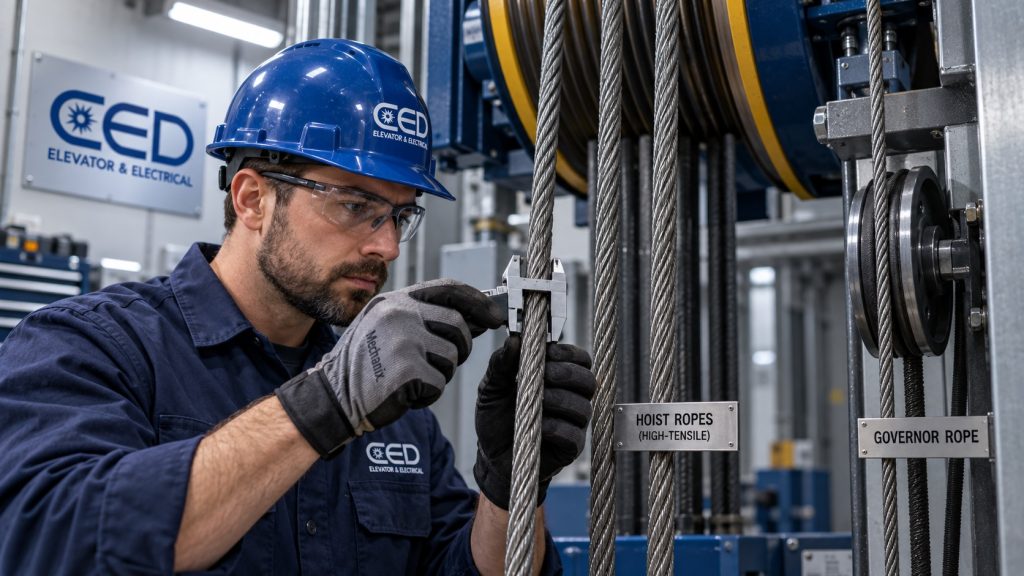
Crown Breaks
Crown breaks occur at the exposed outer surface of the strand, often from bending fatigue combined with surface wear.
Multiple crown breaks concentrated within one rope lay are a strong end-of-life warning.
Valley Breaks
Valley breaks occur between strands rather than on the normal crown-wear surface.
These can indicate internal deterioration and deserve greater concern, particularly when rouge is present.
Quick Reference: ASME Rope Diameter & Discard Checks
Current elevator work should always follow the edition of ASME A17.1/CSA B44 and A17.6 adopted by the local authority having jurisdiction, along with OEM requirements.
| Inspection Item | Field Check |
|---|---|
| Diameter | Measure at the worst location on a straight section |
| Measurement method | Take two readings at 90 degrees |
| Broken wires | Count within the applicable rope lay |
| Crown breaks | Compare distribution and concentration with the adopted code table |
| Valley breaks | Treat as a serious internal-wear indicator |
| Rouge | Apply the stricter code criteria |
| Kink or deformation | Evaluate for replacement under applicable criteria |
| Rope set | Replace as a matched set when required |
Older ASME-derived tables commonly used for reference list a 1/2-inch rope replacement diameter of approximately 0.469 inch under normal wear, with more restrictive limits when rouge or unfavorable conditions are present. Current adopted tables must be checked before condemning or returning any elevator to service.
ASME’s current A17.6 Standard for Elevator Suspension, Compensation, and Governor Systems covers inspection and replacement criteria for elevator suspension means.
Equal Rope Tension Matters Too
Even a correctly specified rope can wear rapidly when load is not shared evenly across the set.
One tighter rope carries more load, sits differently in the sheave groove, and may develop accelerated crown wear. Loose ropes can also create unequal traction and shorten rope and sheave life.
Rope tension measurement and equalization should therefore be part of installation and ongoing maintenance.
CED supplies elevator wire rope and wire rope accessories for traction, governor, modernization, and repair work nationwide.
Match the Rope to the Elevator
At CED Elevator & Electrical, we recommend ordering from the rope data tag and OEM specification rather than relying on diameter alone.
Before placing an order, confirm:
diameter + construction + strength grade + core + lay + rope function + quantity + finished length
Choosing the correct rope protects traction performance, sheave life, ride quality, and long-term reliability.