
Every elevator modernization depends on more than controllers, door operators, fixtures, and major mechanical assemblies. The job also needs the infrastructure that keeps power, signal, control, and traveling cable pathways organized. That means elevator hoistway wiring duct, conduit, wireway fittings, junction hardware, supports, and layout components must be planned before the tear-out begins.
CED Elevator & Electrical supplies elevator products, consumable parts, modernization packages, and field components for contractors across the United States. We have a wide selection of elevator products and parts for more than 25 years and positions its catalog as a “One Stop Shop” for elevator parts.
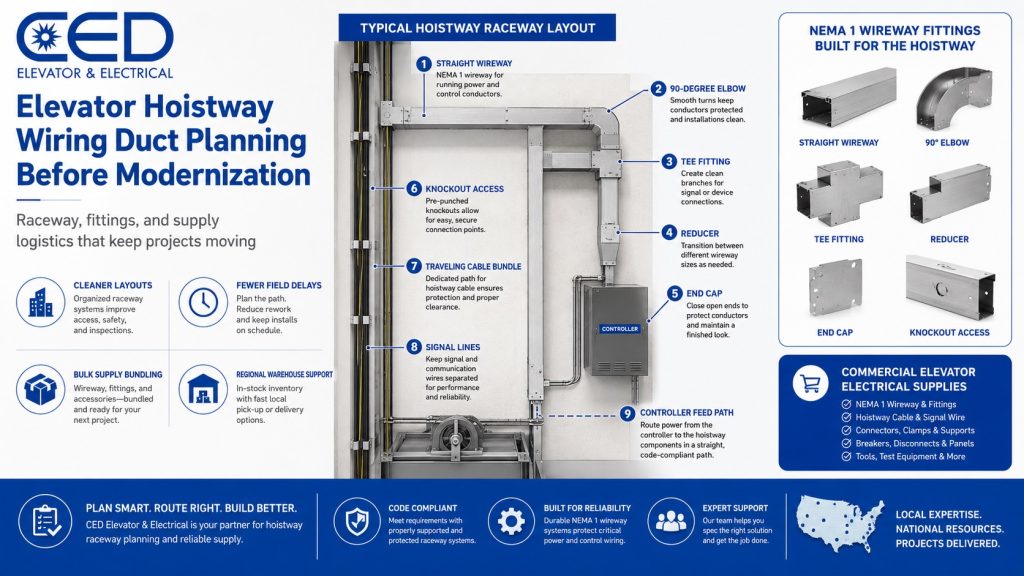
Why Hoistway Raceway Planning Matters
A full modernization can expose old wiring methods, undersized duct, crowded junction points, and improvised field changes. Once crews remove obsolete controls, fixtures, cables, and raceways, the replacement layout must be clean enough for new traveling cable bundles, signal lines, lighting circuits, safety circuits, communication runs, and machine room connections.
For code context, elevator-related conductors, cables, and optical fiber cables in hoistways, machine rooms, control rooms, machinery spaces, control spaces, and cars are commonly required to be installed in approved wiring methods such as rigid metal conduit, intermediate metal conduit, EMT, wireways, or approved cable types, subject to applicable exceptions and local authority requirements.
Elevator Hoistway Wiring Duct Planning Before Modernization
Contractors should source elevator hoistway wiring duct and NEMA 1 wireway fittings before modernization demolition so the new layout can support traveling cable bundles, signal lines, controller feeds, junction points, and service access without field delays. CED Elevator & Electrical stocks modernization materials that include hoistway and traveling cable, wire rope, duct, hydraulic fittings, SmartRise controllers, GAL Canada Linear Door Operators, and ECC hall and cab fixtures.
What NEMA 1 Wireway Fittings Are Used For
NEMA 1 wireway fittings are commonly used in indoor electrical layouts where protection from heavy water, oil, or outdoor exposure is not the main concern. Eaton’s B-Line Type 1 lay-in wireway documentation describes Type 1 wireway as housing runs of control and power cable and being used for cable and wire junction, distribution, and termination. The same documentation notes that fittings allow runs to change direction, junction, and terminate.
For elevator contractors, that matters because modernization layouts rarely move in a straight line. A clean run may need:
- Straight duct sections
- 90-degree elbow assemblies
- Tee assemblies
- Crossovers
- 45-degree elbows
- Reducers
- End caps
- Panel connectors
- Insulated bushings
- Wire support kits
CED’s wireway and fittings catalog includes duct, connectors, panel connectors, 90-degree elbow assemblies, tee assemblies, crossover assemblies, 45-degree elbow assemblies, end cap reducers, reducers, insulated bushings, hatch duct mounting kits, and wire support kits.
Sizing Duct Around Modern Cable Loads
The biggest mistake during a tear-out is replacing old raceway with the same size without reviewing the new controller package, traveling cable, fixture wiring, monitoring systems, and signal pathways. Modern elevator systems can carry more data, safety, access, and communication wiring than the original installation.
A practical planning process should include:
- Map every controller, hoistway device, fixture, hatch location, and machine room connection
- Separate power, control, signal, and communication routing where required
- Confirm knockouts and fittings before crews arrive
- Use lay-in wireway where service access and cable placement matter
- Plan future access, not just first installation
- Confirm all layout details with the elevator contractor, electrician, inspector, and authority having jurisdiction
CED’s catalog lists multiple duct sizes, including 2 1/2 x 2 1/2, 2 1/2 x 4, 2 1/2 x 6, 4 x 4, 4 x 6, 4 x 8, 6 x 6, 6 x 8, and 8 x 8 duct options, giving contractors room to match field conditions and cable volume.
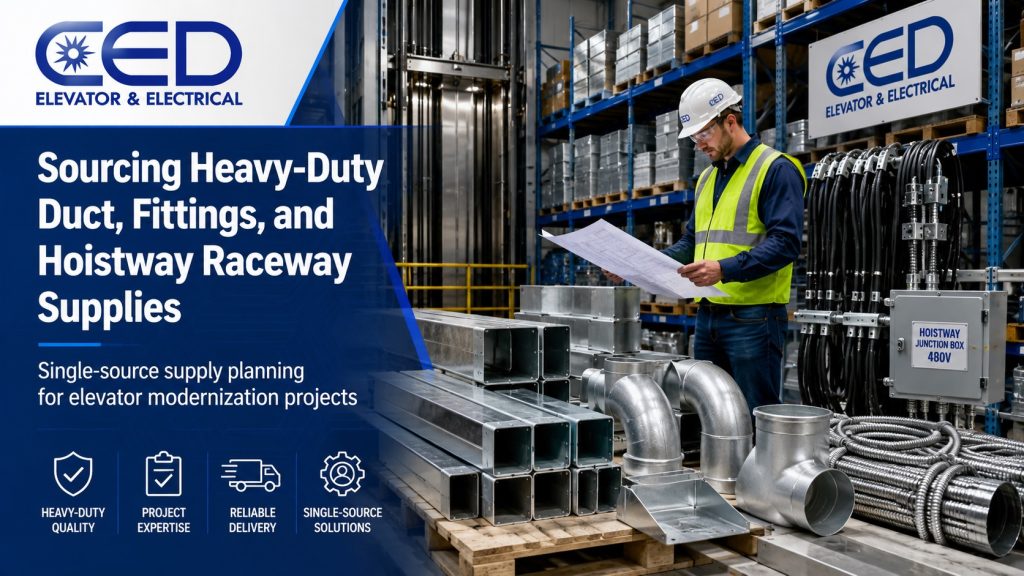
Why Bulk Electrical Components Should Ship With the Main Package
A modernization delay often starts with a small missing part. A controller may be ready, the door operator may be onsite, and the mechanic may be scheduled, but the project still stalls because elbows, reducers, duct, fittings, bushings, or supports were not included in the procurement plan.
That is why our preferred approach is bundling commercial elevator electrical supplies with the larger modernization order. CED’s modernization inventory includes both major assemblies and foundational materials, which helps contractors coordinate hoistway and traveling cable, duct, hydraulic fittings, controllers, door operators, and fixtures from one supply platform.
CED also operates five strategic regional hubs in South Windsor, CT, Long Beach, CA, Chicago, IL, Arlington, TX, and Columbia, MD, with store portals for local inventory, ordering, and shipment tracking.
Contractor Checklist Before Ordering
Before the first material release, gather:
| Planning Item | Why It Matters |
|---|---|
| Hoistway layout | Prevents undersized duct runs |
| Controller package | Confirms raceway and termination needs |
| Traveling cable schedule | Helps size duct and supports |
| Signal line count | Reduces crowded junction points |
| Knockout plan | Prevents field modification delays |
| Fitting list | Keeps crews moving during installation |
| Regional ship point | Reduces freight and lead-time risk |
Modernization Runs on Infrastructure
Elevator modernization success depends on more than the visible equipment. Clean raceway planning keeps cable paths accessible, reduces field confusion, and helps electricians and mechanics work efficiently during a tight shutdown window.
For elevator hoistway wiring duct, NEMA 1 wireway fittings, and commercial elevator electrical supplies, CED Elevator & Electrical gives contractors a single-source path to bundle structural electrical components with major modernization packages, helping teams reduce shipping delays and keep projects moving.