
Type ETT-JC uses a jute center core and is commonly selected for standard elevator hoistways with suspended cable lengths under 200 feet. Type ETT-SC contains a galvanized steel support member and is recommended for suspended lengths over 200 feet or installations with greater mechanical demands. CAT6 does not replace the traveling cable’s power, control, or support components. Instead, shielded CAT6 elements can be integrated into an ETT-SC composite cable to carry Ethernet data for IP cameras, emergency communication interfaces, in-car displays, diagnostics, and connected sensors. CED’s TCSCME14 cable combines two shielded CAT6 elements, six shielded control pairs, and a 5/32-inch steel strength member in one UL ETT-rated cable.
Elevator modernization now requires more than spare control conductors. A single car may need connectivity for a video camera, emergency messaging display, touchscreen, access-control panel, remote monitoring gateway, and multiple sensors.
At CED Elevator & Electric, we help contractors compare mechanical support, conductor count, data performance, cable diameter, and future expansion before a custom length is cut.
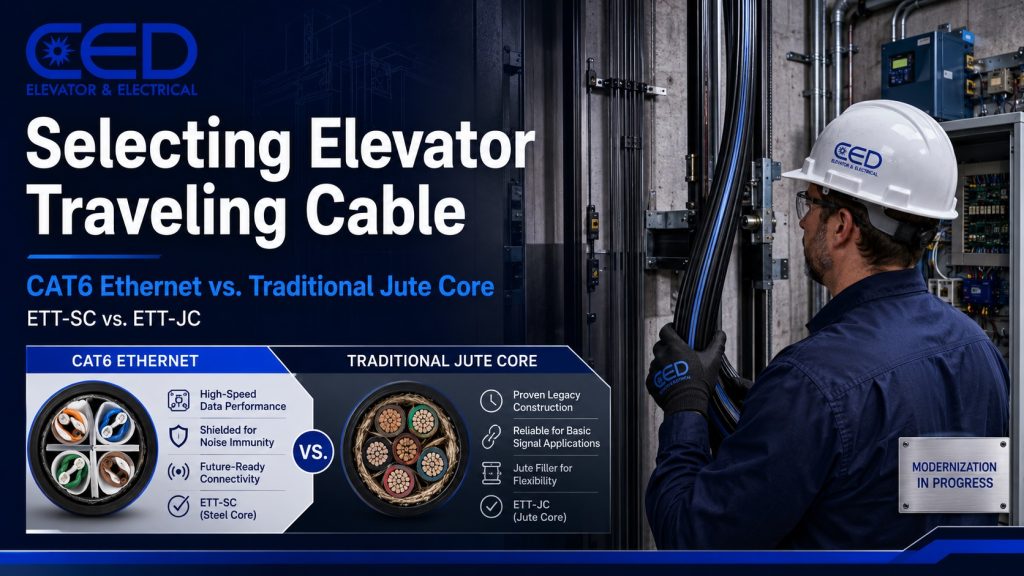
ETT-SC vs. ETT-JC Traveling Cable
The difference between ETT-JC and ETT-SC begins at the center of the cable.
Type ETT-JC Jute Core
A jute core provides a flexible center around which insulated conductors are cabled. CED’s cable catalog identifies ETT-JC for suspended lengths below 200 feet, while the current product category includes configurations with power conductors, control conductors, and shielded pairs.
Jute core commonly fits:
- Low-rise and mid-rise passenger elevators
- Hydraulic elevator applications
- Standard hoistways below the applicable suspended-length limit
- Modernizations with conventional voice and control wiring
- Projects where a separate approved data solution already exists
Jute remains a practical choice when the system does not require an integrated steel support member or high-bandwidth Ethernet connection.
Type ETT-SC Steel Center Core
ETT-SC uses a flexible galvanized steel strength member to carry mechanical stress that would otherwise act on the electrical conductors. CED recommends steel core cable for longer travel distances, high-rise applications, and installations with greater continuous tension. Its cable catalog categorizes ETT-SC for suspended lengths above 200 feet.
Steel core commonly fits:
- Suspended runs longer than 200 feet
- High-rise or long-travel elevators
- Heavy composite cables with numerous conductors
- Modernizations adding cameras, displays, and network equipment
- Hoistways with demanding mechanical conditions
The final selection must follow the adopted electrical and elevator codes, manufacturer hanging-length tables, approved support method, and authority having jurisdiction.
Where CAT6 Fits Into the Traveling Cable
CAT6 is a data-transmission component, not a substitute for the complete traveling cable. Standard stationary Ethernet cable should not simply be attached to a moving elevator cable. The data element must be engineered for repeated flexing and protected within an elevator-rated construction.
CED’s TCSCME14 CAT6 elevator traveling cable integrates:
- Two four-pair CAT6 data elements
- 24 AWG tinned copper data conductors
- Foil and braid shielding
- Six shielded 20 AWG control pairs
- A 5/32-inch galvanized steel strength member
- A reinforced PVC outer jacket
- UL ETT and cUL ETT FT1 ratings
The product specification lists 100-ohm nominal impedance and CAT6 electrical performance for lengths up to 295 feet, or 90 meters.
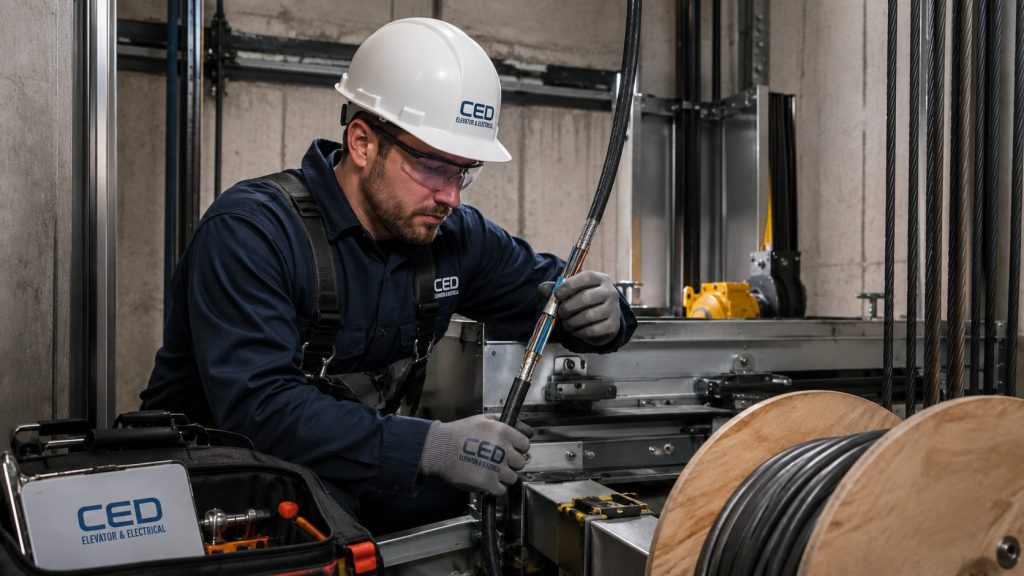
Why Shielding Matters in an Elevator Hoistway
Motors, variable-frequency drives, power conductors, relays, and other electrical equipment can create electromagnetic noise. Shielded twisted pairs help protect voice, data, and video signals from that interference.
CED’s traveling cable guide recommends proper shielding for data, video, and voice systems and notes that CAT5, CAT6, coaxial, and fiber elements may be used based on system requirements.
Shielding still requires correct installation. Contractors should follow the equipment manufacturer’s grounding, bonding, connector, separation, and termination requirements rather than grounding every shield at both ends by default.
Supporting Modern Emergency Communication
ASME A17.1 covers elevator emergency operation and signaling devices. Projects governed by newer adopted editions may require visual, text-based, video, or other communication functions in addition to traditional two-way voice service. Local adoption and project conditions determine the exact requirements.
An integrated CAT6 elevator traveling cable can provide the data pathway needed by:
- In-car emergency messaging displays
- Video communication cameras
- IP-based emergency communication equipment
- Remote monitoring systems
- Multimedia car displays
- Network-connected diagnostic devices
CAT6 cable alone does not create code compliance. The complete communication system, backup power, monitoring service, user interface, network connection, and installation must satisfy the adopted code and approved system design.
Elevator Traveling Cable Specification Checklist
Before ordering cable, confirm:
- Total suspended length and required steel support capacity
- Elevator type, speed, rise, and expected starts per day
- Number and gauge of power and control conductors
- Required voltage and temperature ratings
- Quantity of shielded pairs, coaxial lines, CAT6 elements, or fiber strands
- Data-channel distance and required Ethernet performance
- Finished cable diameter, loop space, and minimum bend radius
- Hanging devices, strain-relief grips, and attachment points
- Spare conductors or data elements for future upgrades
- Required UL, cUL, NEC, ASME, and local approvals
Cable diameter and bend radius should be checked before adding conductors. An oversized composite cable may create tracking, loop, clearance, or service-life problems even when every requested circuit fits electrically.
Order Custom-Spooled Elevator Traveling Cable
CED Elevator & Electric supplies jute core traveling cable, steel core traveling cable, and integrated CAT6 configurations for modernization and new construction.
Request a cable quote with the suspended length, conductor schedule, data requirements, voltage, cable diameter limit, and project location. Our team can help source a custom-spooled Type ETT traveling cable and matching CAT6 or communication wire for the installation.