
MRL traction is generally the stronger choice for buildings with five or more stops, longer travel, higher traffic, or limited room for a separate machine room. Holeless or in-ground hydraulic equipment often provides a more economical solution for two- to four-stop multifamily, retail, medical, and commercial projects. MRL equipment can free usable floor space, but it may require greater overhead and more complex hoistway coordination. Hydraulic packages may have a lower initial equipment and installation cost, but designers must account for a machine room, cylinder arrangement, oil system, and travel limitations. Final pit, overhead, and hoistway dimensions must always come from approved manufacturer drawings.
Elevator selection affects the building core, structural supports, electrical service, pit design, roof elevation, mechanical space, and construction schedule. General contractors and architects can avoid expensive redesigns by comparing traction and hydraulic packages before structural drawings become fixed.
At CED Elevator & Electrical, we support new elevator construction with controllers, traveling cable, hoistway cable, wire rope, door equipment, fixtures, hydraulic components, and installation supplies.
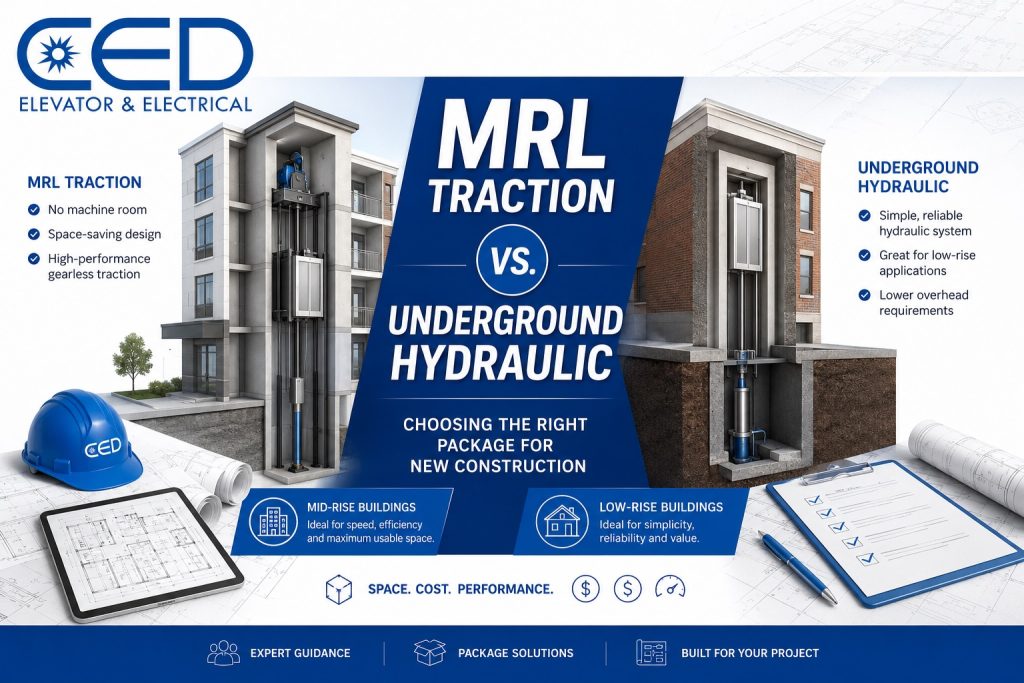
Machine Roomless vs. Hydraulic Elevator New Construction
| Planning Factor | MRL Traction | Hydraulic |
|---|---|---|
| Common application | Low-rise to mid-rise buildings | Low-rise buildings |
| Separate machine room | Normally eliminated | Common with traditional packages, but hydraulic MRL options exist |
| Travel capability | Better suited to longer travel | Commonly used below 60 feet |
| Speed | Generally supports faster service | Common low-rise packages range from 80 to 200 fpm |
| Initial equipment cost | Often higher | Frequently lower |
| Best procurement advantage | Saves building floor area | Simpler, cost-focused low-rise package |
TK Elevator identifies hydraulic equipment as a common choice for buildings with less than 60 feet of travel and reports that it typically has lower installation costs than traction equipment. Current hydraulic products may use either conventional below-ground cylinders or above-ground telescoping jacks.
When MRL Traction Makes More Sense
An MRL traction elevator places major drive equipment within the hoistway rather than in a traditional rooftop machine room. This can free mechanical or rentable floor area and simplify the exterior roof profile.
A current general-purpose MRL traction package from Schindler supports capacities from 2,100 to 3,500 pounds, speeds of 100 or 150 feet per minute, as many as 16 openings, and travel up to 98 feet 5 inches. Those capabilities make traction attractive for mid-rise offices, hotels, apartments, schools, and mixed-use buildings with more demanding traffic patterns.
Traction systems also require suspension components suited to the selected load, machine, speed, and roping arrangement. CED stocks multiple types of elevator wire rope for traction, governor, high-strength, and pre-stretched applications.
Overhead Clearance Requirements for a Traction Elevator
Machine-roomless does not mean clearance-free. The drive equipment, car structure, counterweight, buffers, hoisting beam, and required working clearances still affect the top of the shaft.
One published MRL planning table lists a 5-foot pit and 12-foot-7-inch overhead for several standard configurations with a 7-foot interior cab height. These figures are examples only. Manufacturers expressly state that preliminary brochure dimensions cannot be used for construction without confirmation.
The design team should lock in capacity, speed, door arrangement, cab height, entrances, seismic requirements, and roof structure before finalizing the hoistway.
When Hydraulic Is the Better Package
Traditional hydraulic systems use either a conventional cylinder installed below the pit or above-ground jacks mounted within the hoistway. A conventional in-ground jack can reach greater low-rise travel but requires drilling. A holeless twin-post design eliminates the drilled cylinder by placing the jacks beside the car.
Holeless hydraulic is often well suited to buildings with two to four stops, moderate traffic, heavy passenger or service capacities, and strong pressure to control initial construction costs. Otis lists its machine-roomless holeless hydraulic package for up to four stops, 26 feet 6 inches of rise, and capacities from 2,100 to 5,000 pounds. Other holeless products support two to six stops and travel approaching 50 feet.
CED’s hydraulic elevator power units combine Seim pumps, Imperial motors, and Maxton valves in configurable packages for new installations and modernization work. Available options include oil coolers, pressure gauges, low-oil switches, rupture valves, scavenger pumps, and motor starters.
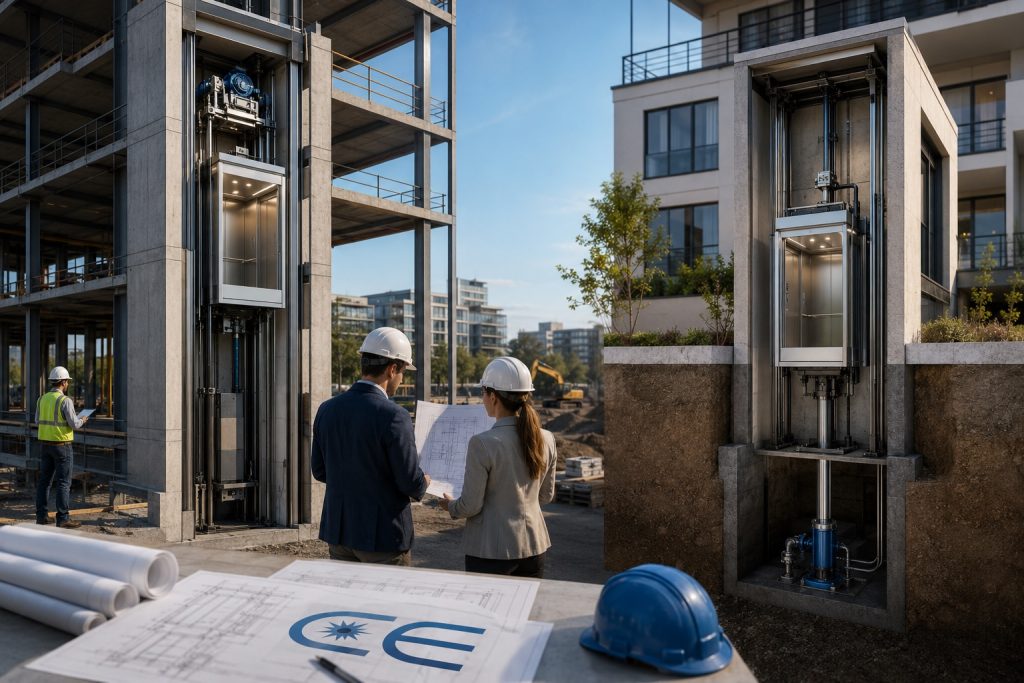
Hydraulic Elevator Hoistway Dimensions Table
The following dimensions are sample front-and-rear-opening holeless hydraulic layouts. They are not universal construction dimensions.
| Capacity | Clear Door | Example Hoistway Width | Example Hoistway Depth |
|---|---|---|---|
| 2,500 lb. | 3 ft. 6 in. | 8 ft. 4 in. | 6 ft. 7 1/2 in. |
| 3,000 lb. | 3 ft. 6 in. | 8 ft. 4 in. | 7 ft. 1 1/2 in. |
| 3,500 lb. | 3 ft. 6 in. | 8 ft. 4 in. | 7 ft. 9 1/2 in. |
The same example shows a minimum machine-room footprint of approximately 5 feet 10 1/2 inches by 6 feet 6 inches, with 7 feet 9 inches of clear height. Door type, entrances, capacity, cab proportions, seismic conditions, and jack arrangement can change every dimension.
Budgeting MRL Traction Elevator Installation Cost
A reliable budget should separate elevator equipment from building-interface costs. Compare the machine room, hoistway area, pit excavation, overhead structure, electrical service, ventilation, drilling, controls, entrances, finishes, freight, hoisting, and installation access.
Hydraulic may deliver the lower initial elevator price, while MRL traction can recover valuable floor area and provide greater travel capacity. The best value depends on the entire building, not the equipment quote alone.
For two to four low-traffic stops, holeless hydraulic often deserves the first comparison. For five to six stories, longer travel, heavier traffic, or limited mechanical space, MRL traction usually becomes the stronger basis of design. Early package coordination lets our team source the right components before structural dimensions and procurement deadlines become fixed.