
ASME A17.1 door restrictor requirements are designed to prevent passengers from manually opening elevator car doors more than 4 inches when the car is outside the permitted unlocking zone. The unlocking zone is generally limited to no more than 18 inches above or below the landing floor level. Compliance may be achieved with an approved mechanical or electronic arrangement, but the correct retrofit depends on the adopted code edition, existing equipment, alteration scope, and local authority having jurisdiction. Connecticut currently identifies ASME A17.1-2013 as its adopted elevator safety code.
A failed door restrictor can turn a routine elevator inspection into an immediate repair order. Mechanics then need the correct device, voltage, brackets, sensors, and mounting hardware without losing days to cross-referencing.
At CED Elevator & Electrical, we help contractors source door equipment, safety components, and elevator modernization materials for legacy and modern systems. Our goal is to keep mechanics moving through inspection lists rather than waiting on hard-to-find parts.
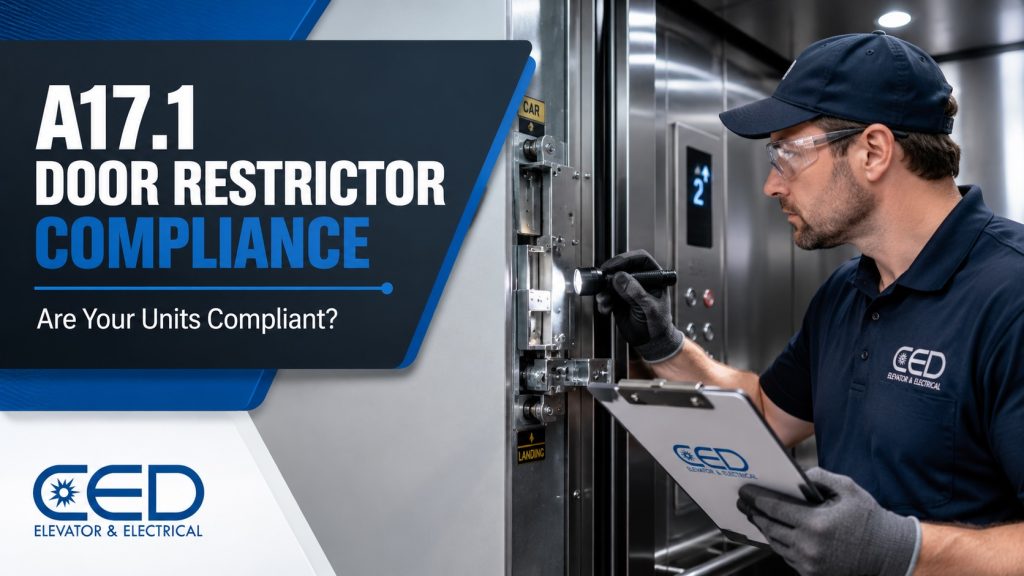
What Does an Elevator Door Restrictor Do?
A door restrictor prevents passengers from forcing the car door open when an elevator stops between floors.
Without this protection, someone trapped inside the cab could open the door into the hoistway. That creates a serious fall and entrapment hazard, especially when the car floor is several feet above or below the nearest landing.
Under the core restricted-opening requirement, the car or hoistway doors must be arranged so they cannot be opened more than 4 inches from inside the car when the elevator is outside the unlocking zone. The unlocking zone generally extends no more than 18 inches above or below the landing floor.
The code establishes the required safety result. It does not require every elevator to use the same brand or restrictor design.
ASME A17.1 Door Restrictors in Connecticut
Connecticut’s official elevator safety page states that the state adopted ASME A17.1-2013 effective January 3, 2018. The Connecticut supplement modifies selected provisions of the model code, so contractors must review both the adopted edition and state amendments before planning work.
That distinction matters because a newly installed elevator, an altered elevator, and an unchanged legacy unit may not be evaluated under identical requirements.
A door restrictor retrofit may become necessary when:
- An inspector identifies excessive manual door opening
- An existing restrictor is broken, missing, or bypassed
- A door operator modernization changes the original arrangement
- A controller or door-system alteration triggers current requirements
- Local enforcement applies a requirement to existing equipment
Contractors should confirm the applicable code edition and retrofit scope with the authority having jurisdiction. A17.1 is the national model safety code, but state adoption and local enforcement determine how it applies to a specific unit. ASME describes A17.1 as covering elevator design, installation, operation, inspection, testing, maintenance, alteration, and repair.
Mechanical Door Restrictors
Older elevators often use mechanical hooks, clutch-mounted locks, rollers, cams, or zone-lock arrangements.
When the car is properly aligned with a landing, the mechanical assembly releases and allows the car door to open normally. When the elevator is between floors, the hook or locking component blocks excessive opening.
Mechanical systems offer several advantages:
- No separate electronic control board
- No photoeye alignment
- Straightforward operation
- Compatibility with some legacy door equipment
However, successful installation depends heavily on geometry. Worn rollers, loose clutch assemblies, damaged hooks, incorrect clearances, and inconsistent car-door alignment can prevent reliable operation.
A mechanical restrictor that works at one landing but fails at another may have a positioning, track, hanger, or clutch issue rather than a defective locking component alone.
Electronic Door Restrictor Kits
Modern electronic restrictors use sensing devices to determine whether the elevator is inside an approved landing zone. A solenoid-controlled plunger or blocking device then releases the door only when the correct zone condition is detected.
The Adams HatchLatch electronic door restrictor stocked through CED uses reflective tape, two photoeyes, and a solenoid-controlled plunger. When the car is inside the landing zone, the sensors allow the plunger to clear the door roller or blocking bracket. Between landings, the plunger remains in its blocking position. The standard assembly includes material for an elevator serving up to five floors, with additional reflective tape available for taller buildings.
Electronic systems can be useful when:
- Original mechanical parts are obsolete
- Door equipment varies across the route
- A cleaner retrofit path is needed
- Mechanical mounting geometry is difficult
- A modernization requires a new restricting method
Electronic does not automatically mean universal. Before ordering, confirm supply voltage, door operator type, available mounting space, door travel, landing-zone arrangement, controller interface, and required fail-safe operation.
Door Restrictor Inspection Checklist
Before ordering replacement parts, document the complete installation:
- Code edition and jurisdiction: Confirm which A17.1 edition and local amendments apply.
- Manual opening measurement: Check how far the car door can be opened outside the unlocking zone.
- Existing restrictor type: Identify mechanical, electromechanical, or electronic operation.
- Door operator information: Record the manufacturer, model, hand, opening type, and voltage.
- Mechanical condition: Inspect hooks, rollers, brackets, clutch parts, fasteners, and clearances.
- Electrical condition: Inspect sensors, wiring, solenoids, relays, batteries, and power supplies.
- Every landing: Test operation throughout the full rise, not only at the main floor.
- Emergency access: Confirm that the arrangement does not interfere with authorized rescue procedures.
The restrictor should also be evaluated alongside interlocks, door contacts, hangers, rollers, and the operator. A new restrictor cannot correct a loose car door, worn track, or badly misaligned clutch.
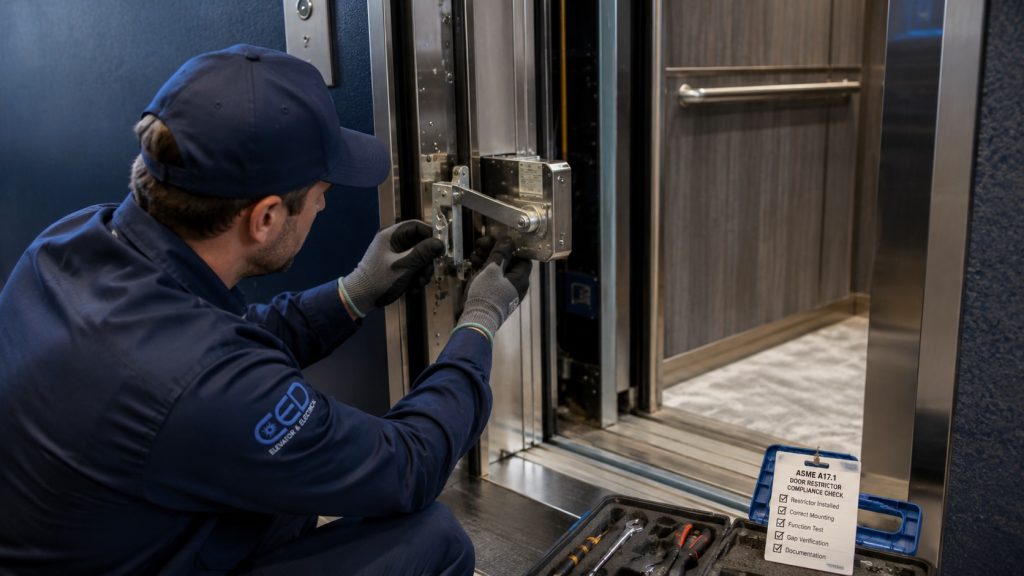
Avoiding Inspection Delays With the Right Parts
Inspection backlogs become harder to manage when every failed unit requires several calls to locate one component.
CED operates as a one-stop elevator parts supplier for service, repair, modernization, and new-construction contractors. We stock consumable parts and coordinated modernization materials, and our team can help cross-reference components for many major elevator manufacturers and systems.
For faster door-restrictor sourcing, provide:
- Elevator manufacturer
- Door operator make and model
- Existing restrictor photos
- Supply voltage
- Number of landings
- Center-opening or side-opening configuration
- Known part numbers
- Inspector correction notice
CED’s South Windsor, Connecticut location supports contractors throughout the Northeast, while additional branches serve Mid-Atlantic, Midwest, Southern, and Western markets.
Keep Door Safety Work Moving
Understanding elevator door restrictor code requirements starts with the 4-inch restricted-opening rule, but successful compliance requires more than ordering a generic lock.
The mechanic must match the device to the door operator, verify operation at every landing, address worn related components, and confirm acceptance requirements with the local inspector.
As an elevator safety parts supplier, CED helps service teams source electronic restrictor kits, door components, and other wholesale elevator components needed to complete code-driven repairs.
Request a quote with the unit information, photos, and required quantities so our team can help identify the correct parts.
Frequently Asked Questions
What is the maximum permitted car-door opening outside the landing zone?
The commonly applied A17.1 requirement limits opening from inside the car to no more than 4 inches when the elevator is outside the unlocking zone.
Are electronic door restrictors code compliant?
They can be when the complete system is approved for the application, installed correctly, and demonstrates the required restricted-opening function. Final acceptance remains subject to the authority having jurisdiction.
Must every old elevator receive a door restrictor retrofit?
Not automatically. Requirements depend on the adopted code, installation date, existing-equipment provisions, alteration history, inspection findings, and jurisdiction.
What information helps identify the correct restrictor?
Provide the operator manufacturer, model, voltage, door configuration, number of landings, existing hardware, and clear photos.